



- Home
- Latest poker news
- Why Didn't Chris Moneymaker Fold J9 on the WSOP Main Event Bubble?
Why Didn't Chris Moneymaker Fold J9 on the WSOP Main Event Bubble?
Chris Moneymaker's finish on the 2026 WSOP Main Event bubble became one of the most talked-about moments of the tournament. In an exclusive interview with ACR Poker, the player explained why he continued with J♥9♦, how he evaluated Antonio Vargas' range, and why he believes his decision was far from a fluke. We analyze the key moments of this hand and the main lessons tournament players can learn from it.
Moneymaker had no intention of sitting out the bubble
By the start of Day 4, Chris Moneymaker's stack had dwindled to around 28 big blinds. While still enough to maneuver, it no longer offered much breathing room. Even so, the ACR Poker Team Pro viewed his first three days in the tournament as a success.
"I think I made a lot of good decisions and was doing pretty well. But by the time we got to Day 4, my stack wasn't exactly great anymore."
Moneymaker stresses that his stack was nowhere near desperation mode. With only seven eliminations separating him from a guaranteed payout, he saw no reason to abandon an active approach and simply wait for the bubble to pass.
"I still had enough chips to keep playing. It wasn't a situation where you could just fold every hand and hope the bubble would just pass."
The last hand of the tournament
Moneymaker opened from the hijack with J♥9♦. Antonio Vargas three-bet with A♥A♠, after which Chris decided to call. On the flop of 8♥ 7♠ 7♦, Vargas bet only 20,000 into a pot of about 96,000, so Moneymaker didn't fold his gutshot.
According to Moneymaker, the small bet sizing was a crucial factor: in his view, his opponent's range remained quite wide.
"I had a gutshot, I was getting good pot odds, and that sizing didn't mean his range had suddenly narrowed to only high pocket pairs."
Turn
The second seven to appear on the board proved to be the turning point of the hand. Vargas placed a bet, and Moneymaker called once again. Although his own hand remained unchanged, the paired board significantly altered the situation, reducing the number of strong value hands Vargas could realistically represent.
Moneymaker also factored in Vargas' tendencies, believing he was capable of applying pressure with a wide range of hands, not just strong ones.
"The third seven completely changed the dynamic of the hand. He had fewer sevens in his range, and now the board's structure became an important part of the equation ."
River
The river paired the board once again, producing a final runout of 8♥ 7♠ 7♦ 7♣ 8♠. Vargas moved all-in, leaving Moneymaker with a difficult decision.
Chris explained that he wasn't expecting to beat Vargas' strongest value hands. Instead, his call was based on the large portion of his opponent's range that would result in a split pot rather than an outright loss.
"I didn't call because I thought J9 beat aces. I did it because I thought his range had enough hands that were just playing the board and that we could split the pot."
Why this call made sense against Vargas
Chris Moneymaker believes the hand only makes sense when viewed in the context of his opponent's playing style. According to him, Antonio Vargas was an extremely active player who frequently applied pressure at the table, making his range appear wider than most players.
"He played very loosely. I would never have played that against most other players."
After the showdown, many focused solely on the fact that Vargas held A♥A♠. However, when making his decision, Moneymaker wasn't looking at his opponent's cards, only at their actions, bet sizes, and the overall dynamics of the game.
That's why Chris emphasizes: this call wasn't an attempt to create a universal rule for bubble play. It was a decision against a specific player, based on the range of hands he expected Vargas to hold.
"When he showed aces, it became obvious that this was exactly the part of his range I was hoping to avoid".
What can you learn from this hand?
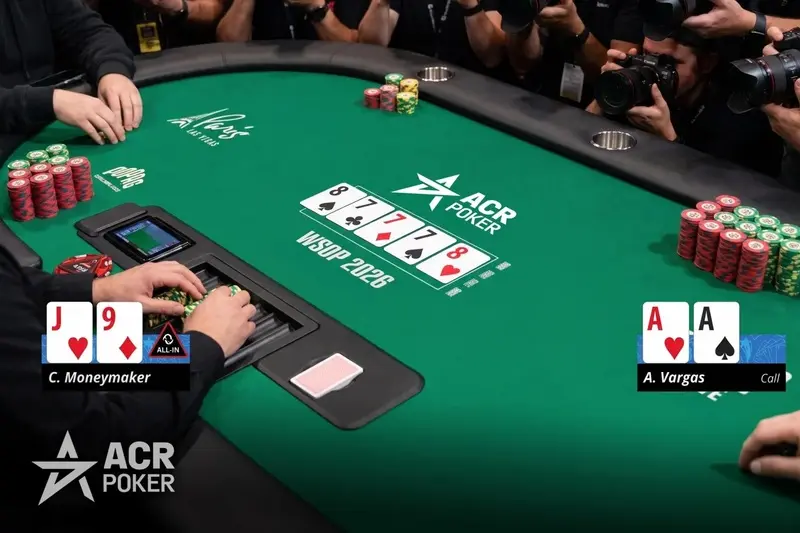
Moneymaker's story demonstrates the danger of analyzing hands solely based on the cards at showdown. Any decision should be assessed based on the information the player had at the time of the game, not after the hand.
Another equally important conclusion: there are virtually no universal decisions in poker. Moneymaker himself admits that against most opponents, he would simply fold his cards before the river. However, regarding Vargas, whom he considered very aggressive, he reached a different conclusion.
"He's probably the only player I'd ever make that call against."
This hand once again reminds us that in tournament poker, decisions are made under constant uncertainty. Even the most experienced players estimate their opponents' ranges, so the quality of their play is determined not by the outcome of a single hand, but by how consistently and logically they make their decisions over the long-term perspective.
ACR Poker has launched Halloween Mystery PKO, a series of three tournaments featuring a new forma...
American poker pro Justin Vaysman won Event #6: $10,500 No-Limit Hold’em at the 2026 Poker ...
British poker pro Patrick ‘Pads” Leonard decided to induce some serious poker nostalg...
Ignition Poker hosts one freeroll every single day. Due to simple entry requirements, each tourna...