



- Home
- Best Poker Rakeback Deals
- Best Online Poker Sites for US Players in 2026
Best Online Poker Sites for US Players in 2026
The United States' federal system makes the US online poker market a complex one, as each state has its own gambling laws: players living in Pennsylvania or Michigan face very different rules than those living in Florida. Regulated online poker is live in only six states, so most players have to turn to offshore or crypto poker sites. CoinPoker is our top pick: it accepts players from all 50 states, and our US players have hundreds of active accounts there. In this guide, you will find the best US-friendly poker sites and which of them accept players from your state.



Top US-friendly poker sites 2026 — quick picks
The online poker market in the United States is divided between regulated and unregulated sites. Here, "unregulated" means the site has no US state poker license. Its legal status and availability still depend on the jurisdiction. In the following table, we include poker sites that passed numerous filters for availability, reputation, traffic, withdrawal options, bonuses, and player experience.
Our ranking favors poker sites available in more states, which fall into the "unregulated" category. However, players residing in regulated states should also include local sites in their evaluation. These sites offer greater regulatory compliance but have significant geographical limitations, traffic restrictions, and limited promotions.
| Category | Poker site | Best for | Welcome bonus | Rakeback |
|---|---|---|---|---|
| ⭐ Best overall | CoinPoker | Crypto natives | 150% up to $2,000 | Up to 90% (Monthly Rake Chase) |
| ✅ Cash games & tournaments | ACR Poker | Large MTTs and constant traffic | 100% up to $2,000 | Up to 65% + Worldpokerdeals deal |
| ✅ Best balance | BetOnline | Poker, sportsbook, and casino in one account | 100% up to $1,000 | From 10% + Worldpokerdeals deal |
| ✅ Softer anonymous games | Ignition Casino | Casual players | 150% up to $1,500 | No rakeback |
| ✅ Largest welcome bonus | Phenom Poker | Bonus fans | 150% up to $3,000 | Up to 40% (Monthly Rake Chase) |
We recommend checking the promotions before creating an account and depositing, as these may vary depending on the player's location.
Which poker sites accept players from your state?
Each online poker room sets its own restricted-state list, shaped by its network, its license, and, for sweepstakes platforms, state law. ACR Poker and Black Chip Poker share the Winning Poker Network and block the same nine states, while on club apps such as PokerBros and ClubGG individual clubs can add their own limits.
CoinPoker accepts players from every state in practice, although its T&C still list the US as restricted, and Phenom Poker publishes no state list, which is not the same as open access. Lists change without notice, so check the site's T&C when you register.
| Poker site | Restricted states |
|---|---|
| CoinPoker | Accepts all 50 states in practice; T&C list the US as restricted |
| ACR Poker | Delaware, Kentucky, Louisiana, Maryland, Michigan, Mississippi, Nevada, New Jersey, Washington |
| BetOnline | New Jersey |
| Ignition Casino | Delaware, Maryland, Nevada, New Jersey, New York |
| Phenom Poker | No published state list |
| Bovada | Arizona, Colorado, Connecticut, Delaware, DC, Kansas, Louisiana, Maryland, Massachusetts, Michigan, Nevada, New Hampshire, New Jersey, New York, Ohio, Pennsylvania, Rhode Island, Tennessee, Vermont, West Virginia |
| PokerBros | No app-level state restrictions (club rules may apply) |
| ClubGG | Connecticut, Georgia, Hawaii, Louisiana, Michigan, Minnesota, Mississippi, Montana, New Jersey, New York, Oklahoma, South Carolina, South Dakota, Washington |
| Stake.us | Arizona, California, Connecticut, Delaware, Idaho, Illinois, Indiana, Kentucky, Louisiana, Maine, Maryland, Michigan, Montana, Nevada, New Jersey, New York, Pennsylvania, Rhode Island, Tennessee, Vermont, Washington, West Virginia |
| Black Chip Poker | Delaware, Kentucky, Louisiana, Maryland, Michigan, Mississippi, Nevada, New Jersey, Washington |
Reviews of the top real money poker sites that accept US players
Each poker site below passed our selection filters, and each one caters to a specific poker player profile.
CoinPoker: best overall for US players
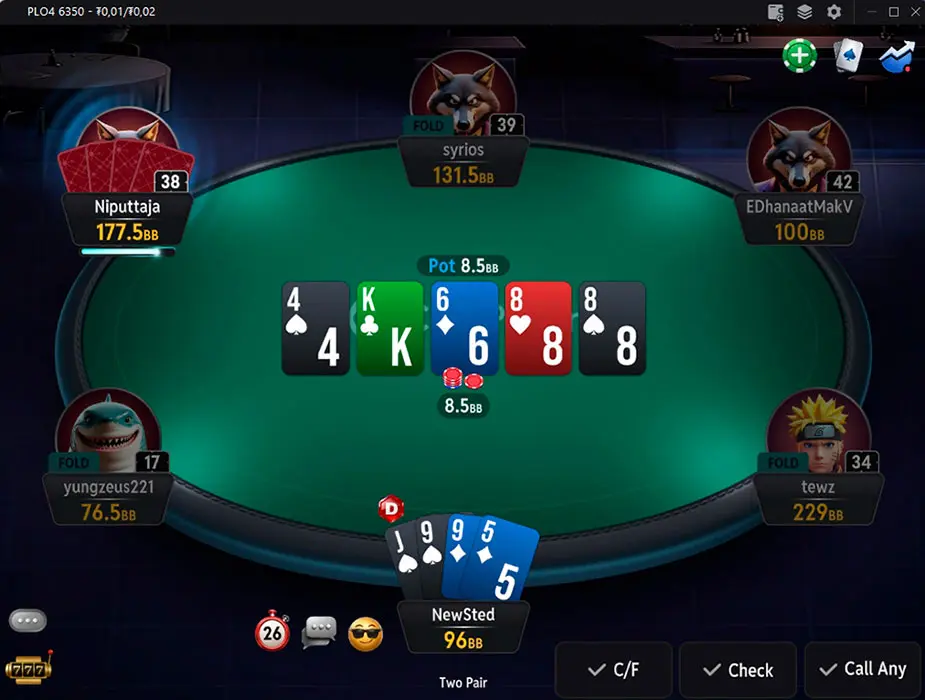
CoinPoker is the right choice for US online poker enthusiasts who prefer their entire gaming ecosystem to be crypto, not just deposits and withdrawals. Games on CoinPoker are played natively in USDT.
On your first deposits, you'll receive a 150% bonus of up to $2,000, accompanied by up to 90% rakeback through the Monthly Rake Chase and prizes from the CoinRaces leaderboards.
Of our five picks, CoinPoker is the only site that accepts players from all 50 states, and our US players play there daily on dozens of active accounts. Officially, though, its terms still list the US as a restricted country: banned on paper, open in practice. Access depends on CoinPoker's current policy, not on a US license, so it could change.
ACR Poker: best for cash games and tournaments
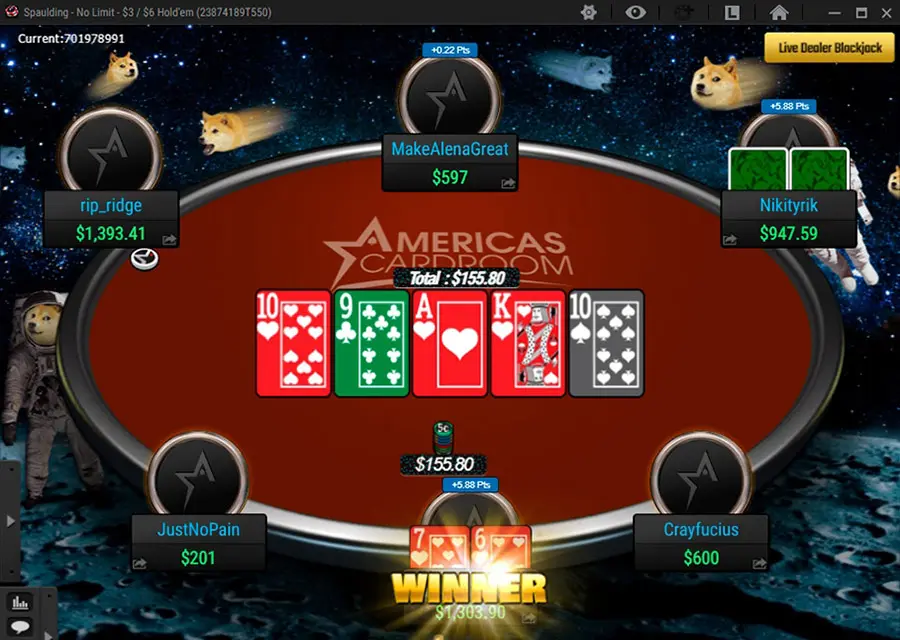
ACR Poker is recommended for experienced American players. While there are some casino games, they aren't heavily promoted, and the site's main focus is poker, with millions of dollars guaranteed in tournaments, higher volume at active cash game tables, and more game formats available. Payments are primarily processed in cryptocurrencies, though some local methods vary by state.
The welcome offer is 100% up to $2,000, and rakeback runs up to 65%, plus an extra rakeback deal through Worldpokerdeals (details from our manager). The site is best known for The Venom, which holds the Guinness World Record for the largest cryptocurrency winning jackpot in an online poker tournament.
During peak American hours, you'll find games such as Texas Hold'em, Pot Limit Omaha, Seven Card Stud, Razz, Spin & Go, fast-fold poker, and much more.
Not available in: Delaware, Kentucky, Louisiana, Maryland, Michigan, Mississippi, Nevada, New Jersey, Washington.
BetOnline: the right balance
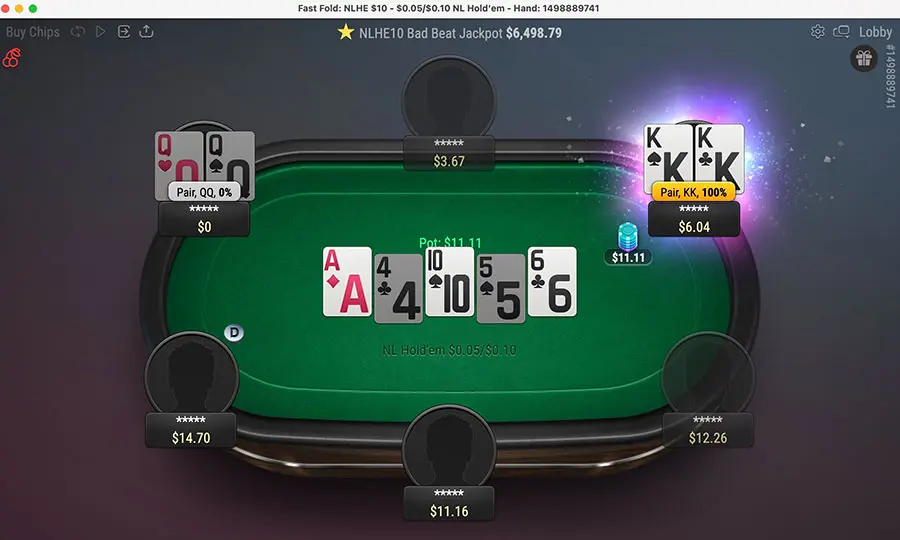
BetOnline suits US online poker players who prefer a well-established poker platform with a broader gaming ecosystem. This site offers various types of betting (including sports betting) and casino games, all in one place. Payment methods are designed with US residents in mind: cryptocurrencies, checks, cards, and more.
Newcomers receive a 100% welcome bonus of up to $1,000. BetOnline's own rakeback starts at 10%, and Worldpokerdeals adds an extra rakeback deal on top (details from our manager).
BetOnline is one of the online poker websites with the most traffic at full-ring (9-max) tables in Texas Hold'em, PLO, Spin & Go, MTTs, and SNGs. All of this is backed by over 20 years of operation, timely payouts, and a good reputation in the market. BetOnline accepts players from every US state except New Jersey.
Ignition Casino: softer anonymous games
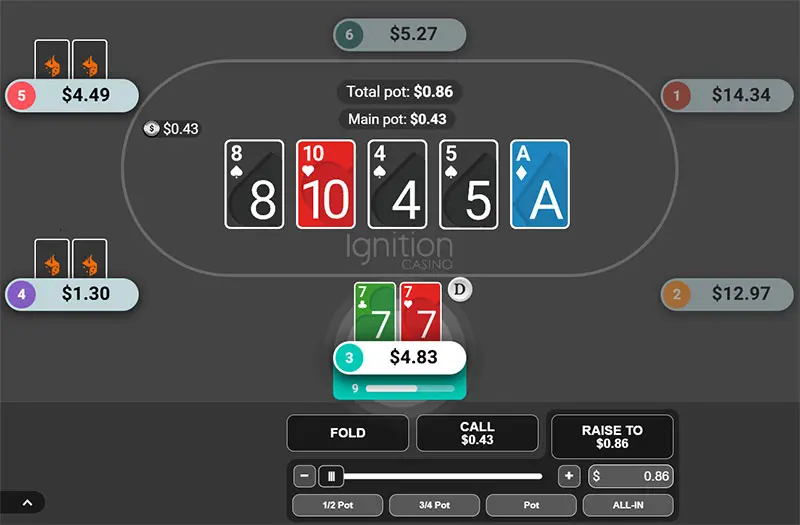
Ignition Casino's poker software is designed to keep poker fun. It offers anonymous tables (which does not mean the site skips KYC) and random table seating, and it has expanded into Latin America.
New players get a 150% welcome bonus of up to $1,500, provided they use Bitcoin for their first deposit. Ignition has no rakeback program.
Not available in: Delaware, Maryland, Nevada, New Jersey, New York.
Phenom Poker: largest welcome bonus
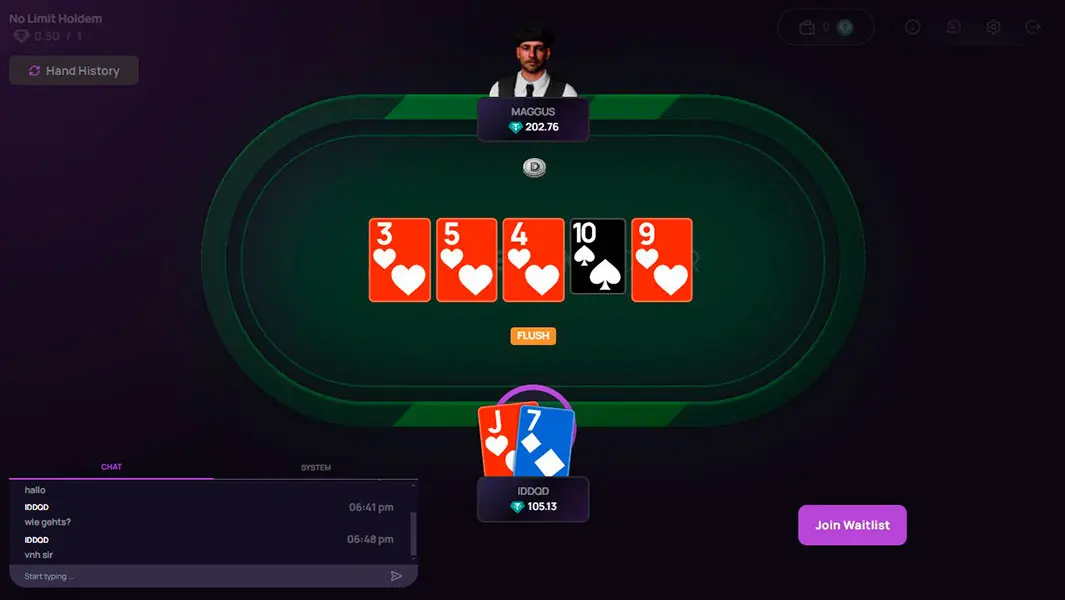
Phenom Poker is a crypto-only poker site with several innovations, including managing player funds through smart contracts rather than centralized wallets. Its US focus is clear: it has built local games for Americans, such as Stud, mixed games, and high-stakes games.
Phenom's welcome bonus is 150% up to $3,000, and rakeback runs up to 40% through the Monthly Rake Chase.


Legal online poker sites in the USA by state
Legal online poker in the United States works state by state. Poker sites cannot operate nationwide by default; they must obtain local licenses, follow state-specific rules, and can only share liquidity with other states through approved multi-state agreements.
If you live in a state where regulated online poker is available, and you are 21 or older, licensed local real-money poker apps might be your first choice for comparison.
If you live outside these states, established international or offshore poker sites may be the main way to access real-money games, but they are not licensed by US state regulators and should be reviewed more carefully before depositing.
| State | Legal poker options |
|---|---|
| New Jersey | PokerStars on FanDuel, WSOP Online, BetMGM Poker, Borgata Poker, PartyPoker |
| Pennsylvania | PokerStars on FanDuel, WSOP Online, BetMGM Poker, Borgata Poker, BetRivers Poker |
| Michigan | PokerStars on FanDuel, WSOP Online, BetMGM Poker, BetRivers Poker |
| Nevada | WSOP Online |
| West Virginia | BetRivers Poker |
| Delaware | BetRivers Poker |
Regulated poker is currently available in only six US states. Our full state-by-state legal breakdown covers each market in detail.
Regulated vs. offshore poker sites
Licensing is one part of the comparison. We also look at payments, traffic, game selection, and promotions.
| Description | Regulated poker sites | Offshore poker sites |
|---|---|---|
| License | Local per state | International |
| Availability | Only in approved states | Wider |
| Oversight | US state regulator | No US state regulator |
| Payments | Local methods, banks, cards | Cryptocurrencies, e-wallets, and local methods |
| Traffic | Reduced, closed liquidity or shared only between states | Global |
| Best for | Players residing in regulated states | Players in unregulated states |
Both offer real-money poker, but their licensing, oversight, and player protections differ. For US players, the options available depend heavily on where they are located.
In short, are offshore online poker rooms safe? As usual, it depends. The offshore sites in this article passed our selection checks, which lowers the risk but does not remove it. If you choose another option, we recommend exercising greater caution.
How do we select the best US online poker sites?
In the United States, the online poker playing field is uneven. Regulated states have very different conditions than unregulated ones. Therefore, the criteria for selecting a site must be adjusted accordingly.
For example, the specific location (the state within the country) carries more weight here than it does elsewhere. It's not enough to simply evaluate "poker sites for the United States"; we need to check each state's regulations.
With this in mind, we use the following criteria to evaluate both types of operator. This table summarizes the minimum requirements an online poker site, regardless of its operating model, must meet to be pre-selected for our list:
| Description | Regulated states | Unregulated states |
|---|---|---|
| ✅ License and availability | Must have a local license | The license takes a back seat, and the site's trustworthiness within the community is evaluated. Bonus points for an international license. |
| ✅ Payment methods | Local banks, options for depositing and withdrawing cash | Crypto at a minimum |
| ✅ Traffic | Traffic may be limited by state size or shared-liquidity access; it's not a strong point of comparison. | Must be strong global ".com" traffic, especially during US evening hours. |
| ✅ Software quality | International standards adapted to local regulations | It must have RNG certification (including blockchain or provably fair). |
| ✅ Bonuses and promotions | They are not a strong point because taxes can make them lower. | They should compensate with better promotions, more rakeback, and a larger welcome bonus. |
| ✅ Poker games variety | Should cover the core formats available in regulated markets: cash games, tournaments, Sit & Go. | Should offer a wider mix of formats, from traditional Texas Hold'em and Omaha Poker to Draw Poker, Razz, and Seven Card Stud, all in tournament and cash game formats. |
Offshore poker sites receive extra scrutiny because they are not licensed by US state regulators. Before adding them to our list, we pay special attention to operator history, player feedback, cashier reliability, crypto withdrawal options, KYC rules, bonus restrictions, and the site's reputation in the poker community. We keep each site's restricted-state list current with its manager and track where our own US players play: on CoinPoker, they have dozens of active accounts.
Is real money online poker legal in the United States?
Quick answers about the legality of online poker in the USA:
- Is online poker legal throughout the United States? No. Regulation varies from state to state.
- Where is online poker regulated? Delaware, Michigan, Nevada, New Jersey, Pennsylvania, West Virginia.
- Can I play in an NJ or PA poker app from another state? No. You must be physically located in the state.
- Are international poker sites regulated in the USA? No. They operate outside the US regulatory system.
- Where do players in unregulated states play? They have several options, such as sweepstakes poker sites, live poker, free social poker apps, and, most popular of all, international (offshore) platforms.
- What should you check first? Availability in your state, withdrawal methods and rules, KYC, promotions, and local laws.
Since there is no general federal law regulating online poker nationwide, each state can adopt its own rules, resulting in the unusual system that operates today, in which only a few states have legal online poker, with rules that vary by state.
For players, this is the most important question when playing: Do I live in a regulated state? This is where the key decision of whether to play on legal sites or offshore sites arises. There is no single nationwide rule that settles whether a player can use an offshore poker site; state rules and the site's terms matter. Offshore sites operate under the regulations of other countries and accept poker players from the USA without a local license.
Eight states have legalized online poker, but only six have operators up and running:
The other two, Connecticut and Rhode Island, have legalized it, but no operator has launched there.
In the other 44 states, no state-licensed online poker site is live. Offshore sites are one real-money option, subject to local rules and each operator's terms.
UIGEA, the Wire Act, and US online poker law

Generally, the regulation of online poker in the United States is summarized in two federal laws: the Wire Act and the UIGEA (Unlawful Internet Gambling Enforcement Act).
The Wire Act was passed in 1961, long before online poker existed, so it's easy to conclude that it doesn't meet current standards and needs. It was designed to regulate interstate sports betting. Over the years, with the rise of online gambling, attempts were made to reinterpret it to adapt it to the new reality; however, recent court decisions suggest that the Wire Act applies only to sports betting and not to other types of gambling.
On the other hand, the UIGEA was passed in 2006 and has had a significant impact on the online poker industry. However, this law is open to broad interpretation and does not classify online poker as illegal in the United States; instead, it focuses on gambling transactions related to illegal games of chance.
This is why the playing field for online poker in the USA is uneven: a licensed poker site can operate only in states where it meets all the requirements, while offshore sites cover the rest of the country.
Multi-State Internet Gaming Agreement and shared poker pools
Beyond limited reach, the main challenge for regulated online poker in the USA is liquidity, since each state has the autonomy to determine whether the player pool is closed (i.e., only players physically located in that state can compete against each other) or open. Closed liquidity greatly affects poker because it is a game between people, unlike sports betting or casino games, which are games against the house.
The MSIGA, or Multi-State Internet Gaming Agreement, was created to solve this problem, at least partially. It allows licensed operators from different states to combine their player pools, making more tables available to everyone.
Delaware, Michigan, Nevada, New Jersey, Pennsylvania, and West Virginia are members of the MSIGA, and the expectation is that new states regulating online poker will join almost simultaneously.
Pennsylvania is the newest member: it joined as the sixth state in April 2025. PokerStars on FanDuel, for example, pools players from New Jersey, Michigan, and Pennsylvania at shared tables.
What about offshore poker sites?
International or offshore poker sites operate under a different regulatory framework both in the United States and in other countries. They are typically licensed in jurisdictions such as Curaçao or Malta, and therefore are not under the supervision of US authorities.
Many offshore sites accept players from the US, particularly from states that have not yet issued formal regulations for online gambling. We are unaware of any cases where players have faced legal issues for playing there, but these sites operate under a different legal framework compared to locally regulated poker sites, which brings financial and legal risks.
Because of this, players should exercise extra caution, applying the selection criteria we use for our list and conducting additional checks that are typically done by the authorities in regulated states. In this case, a site's reliability depends more on its track record than on its documentation.
Deposit and withdrawal methods for US poker players
Legal and regulated online poker sites (though few in number) have a clear advantage over offshore ones in payments. The former generally offer more user-friendly options such as bank transfers, debit or credit cards, PayPal (or similar services), ACH, and even solutions for players with cash. Offshore platforms, on the other hand, typically rely on the quintessential international solution: cryptocurrencies.
Many US players use cryptocurrencies to play on international offshore sites. By using assets like Bitcoin (BTC), Tether (USDT), USDC, Litecoin (LTC), Ethereum (ETH), and others, it's possible to make potentially fast transactions to various operators. However, this involves additional risks and filters, so it's essential to pay close attention to KYC rules and carefully review withdrawal conditions.
While cryptocurrencies offer a practical solution for playing online poker, they add an extra layer of complexity that many may find unnecessary, especially in financial transactions, where trust and security are paramount.
Summary and outlook
Online poker in the US works state by state. Six states have live state-licensed sites, and the regulated market is still moving: PokerStars now operates under FanDuel, and BetRivers relaunched online poker in Delaware in 2025. Everywhere else, offshore sites are the main real-money option, but they hold no US state license, and each one sets its own list of restricted states.
If a state-licensed site is available where you live, compare its games, payments, and player protections with the offshore options. If not, check your state's rules and the site's terms before depositing: the best fit depends on your location and what you value in a poker site.
Responsible gambling
Although online poker is considered by many to be a game of skill, the truth is that for the general public it should be considered entertainment, especially when poker tables are right next to casino games and sports betting. Set limits on your playing (money and time), use the tools that the software provides (such as self-exclusion), and rely on your own support network.
Regulated poker sites have stronger responsible gambling programs, although this doesn't mean that offshore sites don't have them, as the mental health of players is everyone's responsibility. No matter which site you choose to play at, do so responsibly. Support is available through the resources below: