


- Home
- Latest poker news
- Ocean KO on GGPoker: Format Features and Strategy
Ocean KO on GGPoker: Format Features and Strategy
Ocean KO on GGPoker offers a fresh take on progressive knockout (PKO) tournaments. Random multipliers turn standard knockouts into massive jackpots. We explore the mechanics of Ocean KO, how payouts are structured, and the strategy you need to make well-informed decisions at the tables.
What is Ocean KO
Ocean KO on GGPoker is a variation of Progressive Knockout (PKO) tournaments in which the bounty reward for eliminating an opponent is multiplied by a random factor. Unlike standard PKO tournaments, where players receive a fixed portion of their opponent’s bounty, Ocean KO can award a prize that is either smaller or significantly larger than the original bounty value.
The format builds on the Mystery Bounty mechanic but applies a different approach to determining rewards. Instead of randomly drawing a hidden bounty from a prize pool, Ocean KO implements a random multiplier to the opponent’s known bounty value. The reward is then split equally: one half is credited directly to the player’s balance, while the other half increases the bounty on their own head.
Ocean KO was introduced on GGPoker in October 2026. That same month, the $5 Ocean KO Opener attracted 420,084 entries, setting an online poker record for the number of entries in a single tournament. The result highlighted the format's popularity and players' interest in tournaments featuring jackpot-style bounty rewards.
How the reward system works
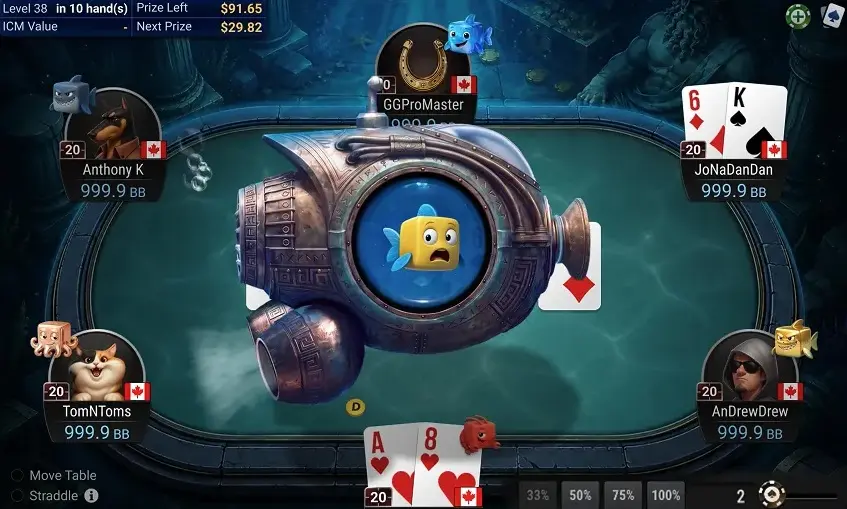
Bounties are active from the first hand (in single-day tournaments without flights). After a knockout, a special Bounty Wheel spins to determine the multiplier applied to the eliminated player's full bounty value.
The resulting amount is split into two equal parts:
- 50% is immediately credited to the winner's balance.
- 50% is added to the bounty for their own head.
For example, if a player eliminates an opponent with a $50 bounty and hits a 2x multiplier, the total reward will be $100. From this amount, the player collects $50 immediately, while the other $50 is added to their own bounty.
If a standard 1x multiplier is hit, the distribution follows the same rules as in a regular PKO tournament. If the result is 0.4x, the player receives only $20: $10 goes to their balance, and $10 is added to their own bounty.
Multipliers and levels of Ocean KO
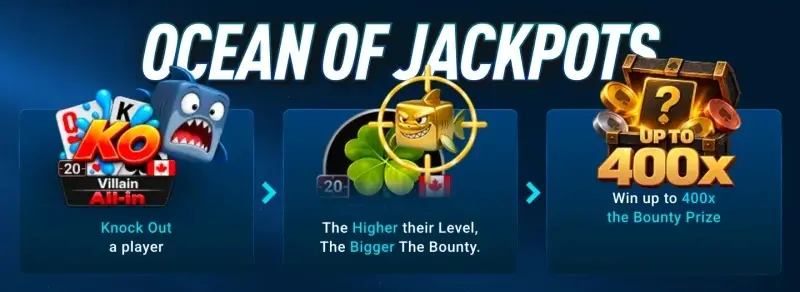
Ocean KO uses multipliers ranging from 0.4x to 400x, with an arithmetic mean of exactly 1x. This means the random mechanic doesn’t increase the average bounty value but redistributes payouts: most knockouts award less than 1x, while rare high multipliers make up the difference.
There are 14 levels in Ocean KO. To advance to the next level, a player should accumulate a bounty of a specific value.
| Level | Name | Required Bounty |
|---|---|---|
| 1 | Egg | 0.5x buy-in |
| 2 | Fry | 0.6x buy-in |
| 3 | Fish | 0.75x buy-in |
| 4 | Shrimp | 1x buy-in |
| 5 | Crab | 1.5x buy-in |
| 6 | Turtle | 2.5x buy-in |
| 7 | Octopus | 5x buy-in |
| 8 | Dolphin | 10x buy-in |
| 9 | Whale | 20x buy-in |
| 10 | Shark | 50x buy-in |
| 11 | Legendary Octopus | $10,000 |
| 12 | Legendary Dolphin | $50,000 |
| 13 | Legendary Whale | $250,000 |
| 14 | Legendary Shark | $1,000,000 |
The first ten levels are tied to the tournament buy-in. The final four levels fall into the "Legendary" category; for those, fixed bounty thresholds are set, which do not depend on the buy-in amount.
As the level increases, the distribution of multipliers changes. A single probability table applies to the first ten levels:
| Multiplier | Probability |
|---|---|
| 400x | 0.002% |
| 100x | 0.08% |
| 10x | 2.4% |
| 2x | 2.5% |
| 1.5x | 2.7% |
| 1x | 20% |
| 0.7x | 22% |
| 0.5x | 26.228% |
| 0.4x | 24.09% |
A dedicated distribution applies to Legendary-tier levels. As the level increases, the available multipliers and the probability of obtaining them change.
| Multiplier | Legendary Octopus | Legendary Dolphin | Legendary Whale | Legendary Shark |
|---|---|---|---|---|
| 0,5x | 45,8% | - | - | - |
| 0,6x | - | 51,25% | - | - |
| 0,65x | - | - | 50% | - |
| 0,8x | - | - | - | 50% |
| 1x | 38,1% | 24,25% | 25% | 30% |
| 1,5x | 12% | 20% | 20% | 20% |
| 2x | 3% | - | - | - |
| 2,5x | - | 4% | 5% | - |
| 10x | 1% | 0,05% | - | - |
| 50x | 0,1% | - | - | - |
Ocean KO game strategy
In Ocean KO, players should consider not only hand strength and stack sizes but also the value of the bounty they could win by eliminating an opponent. However, optimal decisions change as the tournament progresses: preserving chips is more important in the early stages, opportunities to target larger bounties emerge in the middle stages, and ICM becomes crucial on the bubble and at the final table.
Early Stage: don't risk for the starting bounty
At the start of a tournament, stacks are deep, and most players have identical starting bounties. Therefore, there is no need to deviate significantly from a standard MTT strategy for the sake of securing knockouts.
Practical tips:
- Do not widen your calling ranges just for the sake of a small starting bounty.
- Play more pots in position, leveraging your post-flop advantage over opponents.
- Avoid committing your entire stack with marginal hands in hope of hitting a random multiplier.
- Focus on building your stack so that, later on, you can cover more opponents and contend for their bounties.
Middle stage: look for profitable knockout opportunities
As players are eliminated, bounty values begin to vary. Some opponents carry significantly larger rewards, making them more attractive targets.
Practical tips:
- Look for more opportunities to isolate short stacks, especially when you have them covered.
- Be willing to call with a wider range against opponents with large bounties, but only when the potential extra reward justifies the risk.
- Consider not just the immediate payout, but also the future value of the bounty added to your own head.
- If your own bounty has grown significantly, be more cautious about entering large pots against players who have you covered.
Bubble: consider ICM pressure
Before reaching the money, preserving your stack becomes even more important. Even a promising knockout opportunity may not justify the risk of busting before securing an ITM.
Practical tips:
- Avoid making marginal calls against big stacks if losing the hand would result in your elimination.
- Leverage your large stack to apply pressure on opponents who are anxious about busting out before reaching the money (ITM).
- Short stacks should not wait indefinitely for a massive bounty; instead, look for profitable opportunities to shove while you still have sufficient fold equity.
- Evaluate the knockout bounty in conjunction with your probability of survival and your expected tournament payout.
ITM and the final table: don't forget about the prizes
After making the money, and especially at the final table, decisions increasingly depend on the pay jumps between finishing positions.
Practical tips:
- Consider ICM and upcoming pay jumps when deciding whether to call with your entire stack.
- It is advantageous for big stacks to apply pressure on medium stacks and look for opportunities to knock out short-stacked opponents who carry large bounties.
- Medium stacks should be more cautious when engaging with chip leaders, even if there is an attractive reward at stake.
- If a large bounty has accumulated on your head, be aware that your opponents may widen their calling ranges. Reduce the number of marginal bluff-shoves and lean more toward a value-oriented style of play.
Variance and bankroll management
The average multiplier in Ocean KO is 1x, but the multiplier can vary significantly in any individual case.
For regular play, we recommend:
- Maintain a conservative bankroll of at least 300 buy-ins, especially for tournaments with large player pool.
- Track profits from tournament prize money and bounties separately.
- Evaluate the quality of your decisions over a large sample size, rather than based on individual big-multiplier wins.
- Do not increase your buy-in level after hitting a large multiplier.
The key principle of Ocean KO is to pursue knockouts when their potential value justifies the risk to your own stack.
Ocean KO alternatives
Ocean KO isn't the only format in which poker rooms have combined progressive knockout bounties with random payouts. Winamax was the first to introduce this mechanic, and following GGPoker, ACR Poker also launched similar tournaments.
Winamax Space KO
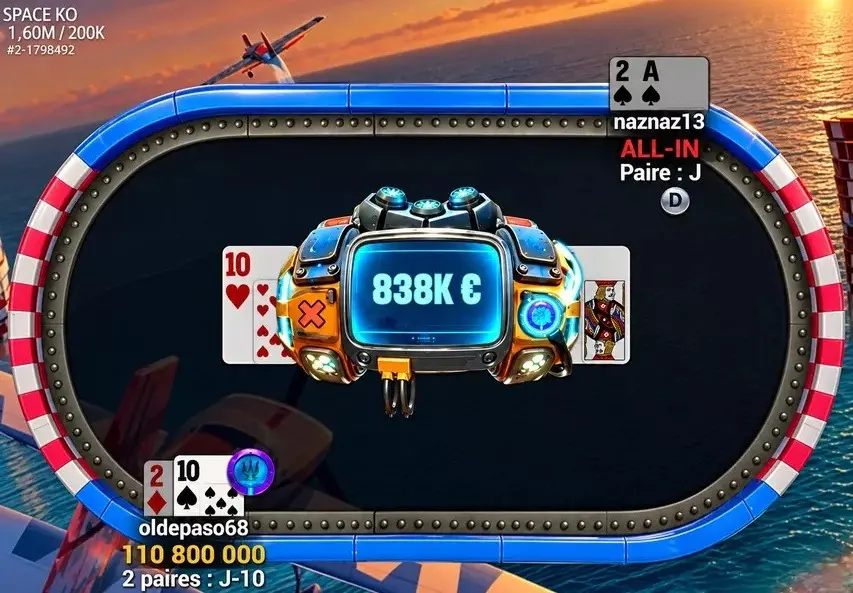
The format was introduced in December 2024. The main difference between Space KO and Ocean KO is the maximum multiplier: Winamax tournaments offer multipliers of up to 100x.
| Multiplier | Winamax Space KO | GGPoker Ocean KO |
|---|---|---|
| 400x | – | 0,002% |
| 100x | 0,10% | 0,08% |
| 10x | 0,50% | 2,40% |
| 3x | 4,50% | – |
| 2x | 12,60% | 2,50% |
| 1,5x | – | 2,70% |
| 1x | 22,30% | 20% |
| 0,7x | – | 22% |
| 0,5x | – | 26228% |
| 0,4x | 60% | 24,09% |
Space KO also features a 14-level system that makes it easy to determine the bounty value of an opponent’s head.
The format has already demonstrated the potential for massive payouts; in September 2026, a single knockout in a €100 buy-in Space KO tournament earned a player €838,000.
ACR Poker Mystery PKO
ACR Poker's Mystery PKO uses a different model. It combines progressive bounties with a hidden prize where the value is revealed only after eliminating an opponent.
When a player is knocked out, the winner receives a Mystery Bounty, which is split in half: 50% is paid out immediately, while the remaining 50% is added to their own bounty. If the eliminated player has already accumulated a progressive bounty, it is also split 50/50.
Unlike Ocean KO, the exact value of a hidden prize in Mystery PKO can’t be identified in advance. Players should estimate the expected value of the remaining Mystery Bounties and consider the prize distribution in the specific tournament.
All poker rooms also run multi-day Jackpot PKO tournaments. In these events, bounties come into play starting on Day 2.
Why Ocean KO appeals to players
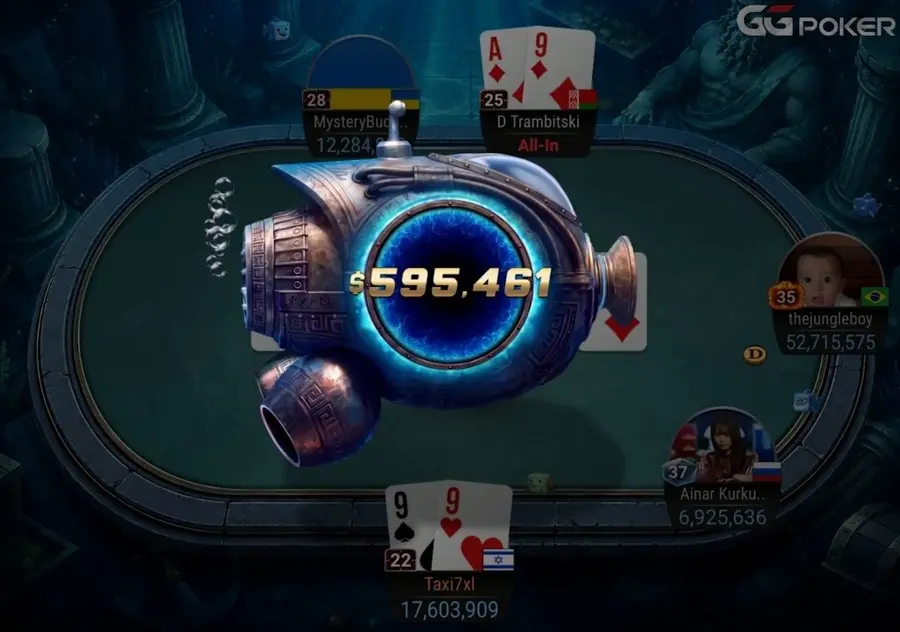
The popularity of Ocean KO lies in the opportunity to secure a large payout for an individual knockout. This format offers several advantages over Mystery Bounty:
- Rewards from the very first hand. In Ocean KO, bounties are available as soon as the tournament begins. In classic Mystery Bounty formats, random rewards are only unlocked once players reach the money (the prize zone).
- Transparent bounty values. Players can see the bounty on every opponent’s head and factor this information into their decision-making. In Mystery Bounty, the value of a prize remains unknown until it is won.
- Greater scope for strategic adjustments. Knowing the bounty values and the range of potential rewards allows players to assess the expected profit from a knockout, select specific targets, and adapt their strategy based on the situation at the table.
- Sustained engagement throughout the tournament. Once a player secures a large bounty, they become a more attractive target for their opponents. This keeps the competition for knockouts intense at every stage of the tournament.
As in Mystery Bounty tournaments, Ocean KO players can win a payout comparable to the tournament's first-place prize without even reaching the final table.
However, not all professionals share the enthusiasm for the new format. Patrick Leonard, for example, believes that the variance is so high that players can only profit consistently by joining a staking or EV-sharing pool, similar to those used by Spin & Go grinders. Chris Brewer, meanwhile, has raised concerns about the potential for cheating, as colluding with friends or other players to target opponents carrying huge bounties could become a serious issue.
Is it worth playing Ocean KO?
Ocean KO is suitable for players who enjoy tournaments with extra rewards for eliminating opponents. However, mastering the basic PKO strategy alone isn't enough to succeed in this format.
Ocean KO is worth playing if:
- You know how to evaluate the potential profit from a knockout, account for the size of bounties and opponents' stacks, adjust your calling ranges, and factor in the Independent Chip Model (ICM) at various stages of a tournament.
- You adhere to a very conservative bankroll management strategy. Ocean KO tournaments combine the high variance typical of standard multi-table tournaments (MTTs) with additional payout fluctuations caused by randomized bounty multipliers. For regular play in such events, a bankroll of at least 300 buy-ins is recommended, especially when participating in tournaments with a large player pool.
- Always keep the core principle in mind: your decisions must be based solely on the expected value of a knockout relative to the risk posed to your own stack.


The final major event celebrating ACR Poker’s 25th anniversary will be a $250 buy-in Myster...
Stake Poker is giving away a package to the WSOP Paradise Super Main Event with a $50,000,000 gua...
Paulius Plausinaitis from Lithuania won the $200K Invitational X event at the Triton Super High R...
At just 21 years old, Wilson traveled to São Paulo to compete in the closing stage of the ...