



- Home
- Latest poker news
- Where Is CoinPoker Legal? Countries and Restricted List 2026
Where Is CoinPoker Legal? Countries and Restricted List 2026
CoinPoker is a crypto online poker room you can reach from most of the world, but "most" now comes with an asterisk. In early 2026 the room rewrote its Terms and, for the first time, named a list of banned countries — the US, UK, Germany, Spain, Australia, the Netherlands and roughly thirty more. Well, on paper, it's a closed door, but in practice, it's still open in many places, with players logging in, depositing and cashing out.


Where can you play CoinPoker?
The simplest way to read CoinPoker's map: you can play from anywhere that isn't on its restricted list — and that's still most of the planet. The poker room doesn't publish an "allowed countries" list because it works by exclusion. If your country isn't named in the banned list below, CoinPoker treats it as open.
That covers most of Latin America, most of Asia, the non-ring-fenced parts of Europe, the CIS, and Africa outside the sanctioned states. Because CoinPoker settles in crypto, there's no bank or card geoblock to trip over. Access comes down to the room's rules and, sometimes, your local internet provider. Read this as availability, not a legal green light: your own country's gambling law still applies, and checking it is on you.
CoinPoker restricted countries: the official 2026 list
Here's the part CoinPoker used to leave vague and now spells out. Clause 1.3 of the 2026 Terms limits play to places where online gambling is legal for you, and clause 3.1m defines a "Restricted Territory" and lists the countries by name.
- ❌
 Afghanistan
 - ❌
 Algeria
 - ❌
 Angola
 - ❌
 Australia
 - ❌
 Bahrain
 - ❌
 Belgium
 - ❌
 China
China - ❌
 Comoros
 - ❌
 Cuba
Cuba - ❌
 Eritrea
 - ❌
 Estonia
 - ❌
 Germany
 - ❌
 India
India - ❌
 Iran
Iran - ❌
 Iraq
Iraq - ❌
 Jordan
 - ❌
 Kuwait
 - ❌
 Libya
Libya - ❌
 Lithuania
 - ❌
 North Korea
 - ❌
 Oman
Oman - ❌
 Pakistan
 - ❌
 Qatar
Qatar - ❌
 Saudi Arabia
 - ❌
 Spain
Spain - ❌
 Syria
Syria - ❌
 Tunisia
 - ❌
 Turkey
 - ❌
 UAE
UAE - ❌
 United Kingdom
 - ❌
 United States
 - ❌
 Netherlands
 - ❌
 Yemen
Yemen
From the same Terms, accessing CoinPoker from a restricted territory lets the room block the account, void transactions and withhold funds. In other words, the rule has teeth on paper, and the risk sits with the player.
Banned on paper, open in practice — what actually happens
A restricted list and a closed door aren't the same thing. Since the list appeared, we haven't seen a spike in blocked accounts, frozen balances or failed withdrawals from players in those countries. Support usually answers access questions by pasting the Terms — no case-by-case guidance, but no active purge either.
Our own test makes the point. An editor based in the UK, one of the strictest markets on the list, logged into the CoinPoker app and played cash games and tournaments with nothing more exotic than a normal connection.
Our read: the 2026 additions look like language written for regulators (the right words in the Terms), rather than a switch that was actually flipped. Treat that as a read, not a promise. The clause is real, CoinPoker can enforce it whenever it chooses, and if it does, your balance is the collateral. Play a restricted market and you're accepting that risk with open eyes.
Is CoinPoker legal in the US?
The US is squarely on CoinPoker's banned list, yet US players keep getting in and cashing out anyway. The Terms name the United States along with its dependencies and territories. It's the same paper-versus-practice gap described above.
The legal backdrop is a patchwork. A handful of states have legalised and regulate online poker under their own law; most leave it unregulated or in a grey area. As of 2026, online poker is regulated in:
- New Jersey
- Nevada
- Delaware
- Pennsylvania
- Michigan
- West Virginia
- Connecticut
- Rhode Island
- Maine
None of this makes CoinPoker legal in those states. The poker room holds no US state licence and runs offshore on its Anjouan licence, and its Terms restrict the entire US including regulated states. A "regulated" state only means online poker is lawful there on locally licensed sites, not on CoinPoker.
So the bottom line for a reader is blunt: CoinPoker will likely let you in, the Terms say you shouldn't be there, and the legal exposure is yours.
Can you use a VPN on CoinPoker?
A VPN can get you back onto the site; it can't get you onto the right side of the law. When access fails, it's usually your internet provider blocking the domain, not CoinPoker blocking you. Two fixes people use are switching DNS — the setting that turns a site's name into an address, for example Cloudflare's 1.1.1.1 — or a VPN. We saw provider-level blocks in markets like Spain and Turkey, and a DNS change or VPN brought the site back.
Two cautions come with that.
- VPN changes what your provider sees, not what your law says: if online poker is illegal where you live, routing around a block doesn't make it legal.
- Logging in from a restricted territory still trips the Terms in the section above, so you're carrying the same account-and-funds risk.
Keep it consistent, too. Bouncing between a VPN location and your real one and then trying to withdraw is exactly the kind of mismatch that invites a manual review. Treat a VPN as an access tool, not a legal one.
How do you check if CoinPoker is legal where you live?
- Read your local law. Look up whether online or offshore poker is legal, restricted or a grey area where you live — that's the ruling factor, above anything CoinPoker says.
- Check the restricted list. If your country is named in the section above, the Terms already say no; playing anyway is at your own risk.
- Run a test login. Create an account and try a small deposit. If the app opens and funds move, access works — which still isn't the same as legal.
Always remember: you must be at least 18 (or older, where your law sets a higher bar), and CoinPoker verifies accounts by phone and SMS with a light KYC identity check, so keep a working number handy.
Is CoinPoker safe and licensed?
CoinPoker carries a gambling licence and a roster of well-known pros. The room is licensed by the Anjouan Gaming authority and operated by Precise Interactive Inc., a Panama-registered company. Among crypto poker sites, holding any licence at all is still uncommon, but an Anjouan licence is lighter-touch than a UKGC or MGA one, so read it as a baseline signal rather than a guarantee.
On the human side, its Team Pro features names the poker world knows: Patrick Leonard, Benjamin "Bencb" Rolle, Mario Mosböck, Nik "Nik Airball" Arcot, Jean-Robert Bellande, Mariano Grandoli and Brantzen Wong. For the full trust breakdown — game integrity, track record and payouts — see our CoinPoker review.
How do you pay on CoinPoker?
Short version: stablecoins in, stablecoins out. CoinPoker now runs on USDT and USDC; the old CHP token is no longer supported.
Deposits — crypto plus Luxon Pay:
- BTC
- USDT
- USDC
- ETH
- SOL
- POL
- BNB
- TRX
- Luxon Pay
Withdrawals:
- USDT
- USDC
What's the rakeback deal?
CoinPoker doesn't run a classic loyalty ladder. Instead, rake flows back through CoinRaces leaderboards (a monthly prize pool around $7 million — real cash added on top of what you win at the tables), Splash Pots cash drops, personal missions, and the 3-Bet Club subscription (up to 15% rakeback — up to $15 back for every $100 of rake you generate).
Through Worldpokerdeals you also get the Monthly Poker Rake Chase: fifty fixed-prize levels worth up to $5,000, on top of 20% rakeback — $20 returned for every $100 of rake you pay. Sign up through the link on our site and enter promo code WPDEALS during registration to unlock the better deal.
About CoinPoker
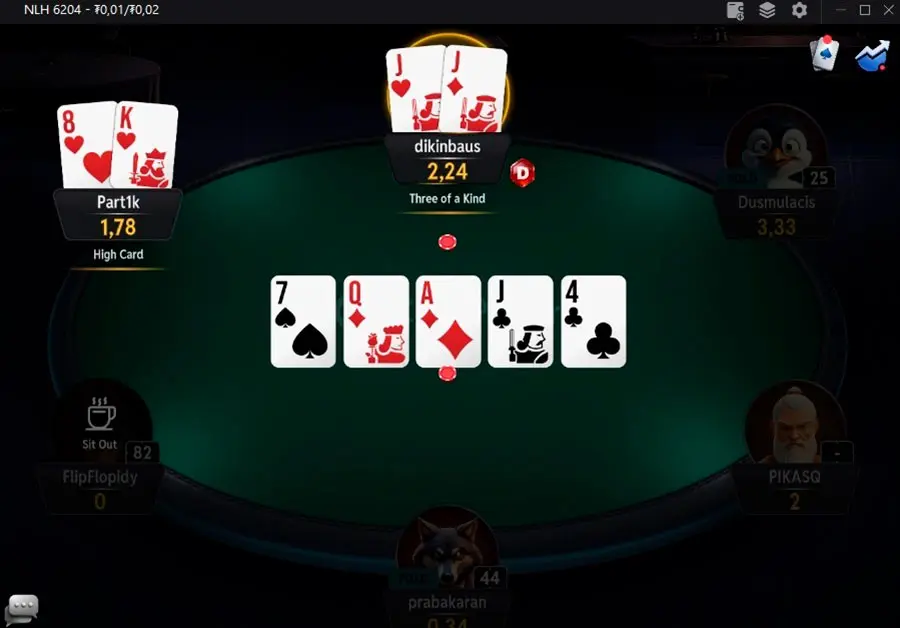
CoinPoker launched in 2018 and settles everything in USDT, so balances and cash-game stacks don't swing with the crypto market. The game spread is wider than most crypto rooms: No-Limit Hold'em, PLO and the big-pot variants PLO5 and PLO6, All-in or Fold, plus a full tournament schedule and side casino. Cash tables run from micro stakes all the way up to 5K/10K, and the Sunday majors carry a combined guarantee north of $2.5 million.
Traffic sits around 7,000 players at European peak, heaviest in the afternoons, and there's no cap on how many tables you can open at once. The client is proprietary and cross-platform (Windows, macOS, Android, iOS), with a built-in HUD and hand analysis, though third-party trackers aren't allowed. Account verification stays light: a phone number is all you need to play, and CoinPoker only asks for ID in high-stakes or flagged cases rather than as a default KYC step.


Frequently asked questions (FAQ)
CoinPoker continues to hit new milestones. The poker room has announced "The One" $5,000,000 GTD,...
CoinPoker launched an exclusive K-Poker cash game format that offers a fresh take on traditional ...
CoinPoker has received significant advertising space on one of the major poker shows. In August 2...
On CoinPoker, the cashier trips up more new players than the tables do. Pick the wrong method and...