



- Home
- Latest poker news
- Best Online Poker Sites in New Jersey: Where to Play in 2026
Best Online Poker Sites in New Jersey: Where to Play in 2026
New Jersey is one of the few U.S. states where online poker is fully legal and regulated, with licensed operators overseen by the New Jersey Division of Gaming Enforcement. That said, choosing the right site goes beyond legality; it’s important to consider player traffic, shared liquidity with other states, and the differences between platforms such as WSOP Online, BetMGM, Borgata Poker, and PokerStars / FanDuel.
Some players still look at offshore poker sites, mainly because of cryptocurrency payments and more generous bonus structures. This review covers the platforms available to New Jersey residents and visitors in 2026, along with key regulatory details and the main factors to consider when choosing where to play.
Best sites to play online poker in New Jersey (2026)



If you live in New Jersey and want to play online poker, you generally have two choices: state-licensed platforms or US-friendly offshore sites. The first option offers a regulated environment overseen by the New Jersey Division of Gaming Enforcement, with strict rules, identity checks, and mandatory geolocation. As of 2026, players in the state can access WSOP Online, BetMGM Poker, Borgata Poker, and PokerStars/FanDuel.
| Poker Room | Shared Player Pool | Tournament Highlights | Key Features |
|---|---|---|---|
| WSOP.com NJ | NJ, NV, MI, PA | WSOP Online Bracelet Events, Circuit Series, Sunday Major | Largest interstate pool, high traffic, linked to Caesars Rewards. |
| BetMGM Poker NJ | NJ, MI, PA | Heart Championship, Spade Championship, Spin&Go up to $100,000 | Developed promotional ecosystem, good traffic, BetMGM/Borgata network. |
| Borgata Poker NJ | NJ, MI, PA | Borgata Winter Poker Open satellites, BetMGM/Borgata network series | Same shared liquidity as BetMGM, but a separate brand with a strong connection to Borgata. |
| PokerStars / FanDuel NJ | MI, NJ, PA | PokerStars US COOP series, Mystery Bounty Builders, freeroll series | Well-developed PokerStars software is integrated into the FanDuel ecosystem. |
From a practical standpoint, licensed online poker rooms in New Jersey remain the safest choice for most players. They operate under state oversight, use reliable payment methods, and provide access to shared player pools across multiple states. WSOP Online offers the largest licensed network along with a strong tournament schedule, while BetMGM and Borgata Poker appeal to players who value promotions and connections to major casino brands. Meanwhile, PokerStars / FanDuel remains a familiar choice for those who prefer PokerStars’ software and established tournament formats.
Offshore poker rooms serve as an alternative for New Jersey players. While they are not regulated at the state level and lack the protections provided by sites overseen by the DGE, some players are drawn to them for features like cryptocurrency payments, access to international player pools, and more flexible bonus or rakeback structures.
CoinPoker
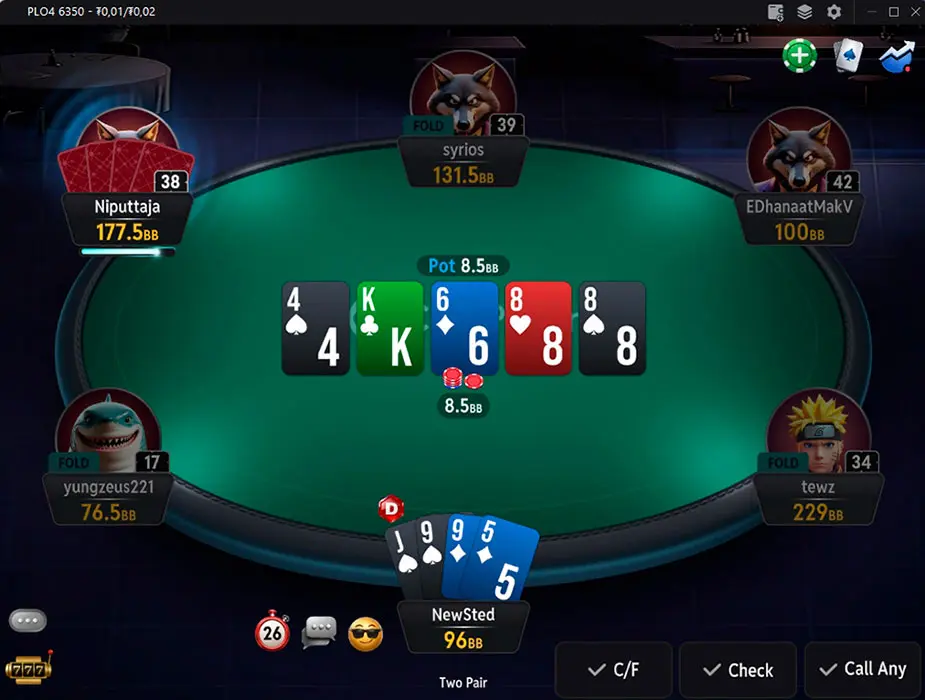
CoinPoker is one of the few offshore online poker rooms that continues to accept players from New Jersey, making it a practical alternative for those who want to play online poker using cryptocurrency.
The cashier supports Bitcoin, USDT, and USDC for both deposits and withdrawals. Player accounts remain anonymous, with no verification required.
Most of the room’s traffic is focused on 6-max Hold’em and Omaha tables, with stakes ranging from $0.01/$0.02 up to $1K/$2K.
The tournament lobby features events across a broad spectrum of buy-ins. New players can get started with freerolls, while high rollers regularly compete in MTTs with buy-ins ranging from $1,000 to $5,200.
CoinPoker’s bonus structure allows players to earn solid rakeback even without playing heavily. The 150% welcome bonus of up to $2,000 delivers 33% rakeback, while the loyalty program guarantees a fixed 15% rakeback paid every day. Active grinders can also earn additional daily rewards in rake races.
WSOP.com

WSOP.com is the online poker room of the world’s most recognizable poker brand and the traffic leader among licensed online poker sites operating in New Jersey.
Its key advantage is a shared player pool spanning four states — New Jersey, Nevada, Michigan, and Pennsylvania. This combined liquidity ensures consistently active cash games across multiple stake levels, while the flagship Sunday Major tournament features a $100,000 guaranteed prize pool.
The lobby includes NLH, PLO, and PLO Hi/Low cash games with stakes up to $100/$200. Players can also find classic Sit & Go tournaments and Blast Spin & Go, with buy-ins ranging from $0.20 to $100.
WSOP.com’s tournament schedule includes events with buy-ins of up to $1,000, with the Big Sunday MTT alone featuring a $320,000 guaranteed prize pool. The platform’s main attraction, however, is the official WSOP Online series, where players can compete for real gold WSOP bracelets, an exclusive feature available only on this licensed U.S. poker site.
New players at WSOP.com can claim a 100% welcome bonus of up to $400 on their first deposit. Loyalty points earned through rake can be exchanged for tournament tickets and bonuses, and they can also be used within Caesars Rewards, Caesars Entertainment’s unified loyalty program.
BetMGM Poker NJ
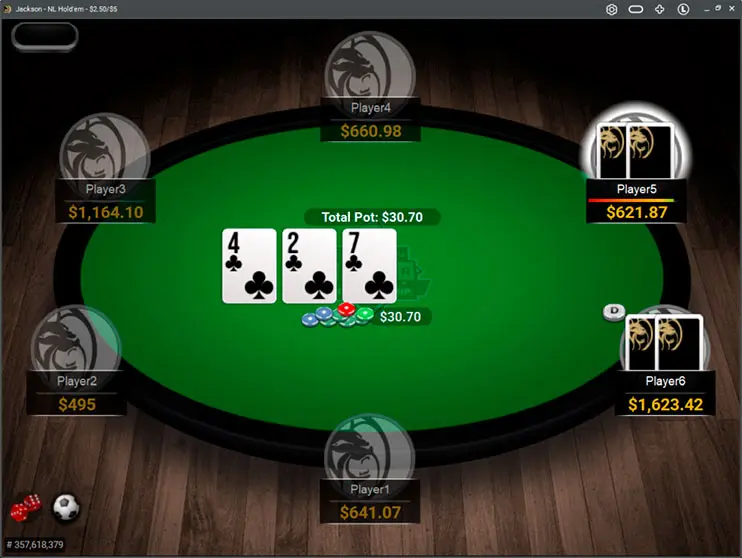
BetMGM Poker is the online poker room of BetMGM, a major American gaming company that also operates in the U.S. offline gaming industry. The poker room operates a shared player pool across New Jersey, Michigan, and Pennsylvania.
Most of the action at BetMGM Poker NJ is concentrated on Hold’em cash tables up to NL$500, with additional Omaha games and higher-stakes tables reaching $25/$50.
The tournament offering includes classic heads-up and 6-max Sit & Go, Spin& Go with random prize pools of up to $100,000, and a robust MTT schedule with buy-ins of up to $530. BetMGM Poker NJ also regularly runs major tournament series, such as the Borgata Poker Open and the Aria Poker Open.
What sets the room apart from competitors is its wide range of promotional offers:
- 100% first deposit bonus up to $1,000 plus up to $85 in tournament tickets.
- Daily Cashback Grind loyalty program with payouts of up to $125 every day.
- Hot Tables cashdrops.
- Weekly SPINS Leaderboards with payouts of up to $1,000.
- Happy Hours with double loyalty points.
How we rate poker sites for New Jersey players
The NJ online poker market is structured differently from that in most other states. Here, players have access not only to locally licensed rooms but also to offshore sites. In theory, it's all simple: just sign up on any site and play. In practice, things are a bit more complicated. One platform may stand out for its high traffic and major tournaments, another for its bonuses and software, and a third for its fast payouts.
In this review, licensed New Jersey sites and offshore platforms are treated separately, as they represent distinct categories from a regulatory standpoint. Licensed sites are assessed as part of a regulated market with DGE controls, geolocation, and interstate liquidity, while offshore sites are considered alternatives for players seeking cryptocurrency, an international pool, or more flexible bonus terms, but who understand the risks of a lack of state-level protection.
That's why we don't rely solely on brand recognition. What's more important to us is how a room performs in real play: how stable it is, whether there's enough action, how the payments work, and whether players have reason to trust the website. To evaluate this, we focus on the following key criteria:
- Poker room license and status. New Jersey is a fully regulated state where licensed poker rooms operate under strict oversight from the Division of Gaming Enforcement (DGE). When evaluating international sites, we prioritize platforms licensed in reputable jurisdictions such as Gibraltar or Curacao with a proven track record. We also place strong emphasis on independent audits by organizations like eCOGRA or iTech Labs, as they confirm fair RNG performance and overall integrity.
- Traffic and player pool. For New Jersey, this is one of the most important criteria. We assess how active the lobby is, whether there’s a sufficient selection of cash games and tournaments, and if the platform shares its player pool with other states.
- Brand reputation. Not every well-known site automatically deserves a spot in our selection. We care about the room's history, its reputation in the poker community, the overall brand image, and whether it's been subject to any serious criticism.
- Payments and security. In real money poker, smooth and reliable payments are crucial. We evaluate payout speed, transparency of terms, cashier convenience, verification speed, and the variety of available payment methods. Cryptocurrency remains a distinct advantage for some players, but this doesn't negate the importance of traditional payment methods.
- Bonuses and additional benefits. A large bonus alone doesn't mean anything. We look at the broader picture: does the room have a robust promotional system, leaderboards, rakeback, or other offers that actually generate profit over time, not just on the first day after registration.
- Interface. We consider not only the room's feature set but also how convenient it is for everyday play. Clear navigation, stable client performance, table loading speed, lobby usability, and the overall software experience all play a key role.
These are the criteria we use to separate the ordinary sites from those truly worthy of the attention of New Jersey players.
We monitor this review and update it whenever conditions for New Jersey players change, including state legislation, interstate liquidity regulations, the availability of individual sites, or poker operator policies. Online poker sites may change verification requirements, bonus terms, payment methods, limits, and tournament schedules, so we strive to promptly update this information if such changes impact a player's actual choices.
Online poker in New Jersey
New Jersey remains one of the most developed US states in terms of online poker. The legal market has been operating here for over a decade, so online poker has long been a stable part of the local gambling industry.
The state's main feature is not only the presence of licensed poker rooms, but the high level of competition between them. For players, this means higher traffic and regular tournament series.
Of particular importance is the shared player pool with other states where online poker is also legal (for example, Nevada, Michigan, and Pennsylvania). Thanks to this unified market, tables remain active around the clock, and the tournament schedule becomes more diverse. This gives New Jersey a clear advantage over many other U.S. states.
However, licensed poker rooms are not the only option available to local players. Some players still choose to play on offshore sites, particularly if they are looking for cryptocurrency payment methods, flexible deposit limits or higher traffic.
Is online poker legal in New Jersey?
Yes, online poker is legal in New Jersey. Assembly Bill 2578 (A2578), which officially legalized online gambling in the state, paved the way for the launch of the regulated market. Today, all industry activity is subject to strict regulations outlined in the Casino Control Act, and enforcement of these standards is overseen by the New Jersey Division of Gaming Enforcement (DGE). Gambling is permitted only via the sites affiliated with licensed state casinos and part of the official online gaming system.
The rules for players are straightforward: you must be at least 21 years old, complete identity verification, and be physically located in New Jersey while playing. Residency is not required, so visitors can also participate as long as they pass geolocation checks and use a licensed platform. Operators, in turn, are required to implement verification procedures and responsible gaming safeguards.
Practical online poker scenarios in New Jersey:
| Situation | Can you play? | Explanation |
|---|---|---|
| You live in New Jersey and play from home. | ✅ | Yes, as long as you are 21 or older, have completed verification, and your geolocation confirms that you are within the state. |
| You are visiting Atlantic City or another city in New Jersey. | ✅ | Residency is not required; what matters is your physical location. |
| You live in New York but are physically located in New Jersey. | ✅ | Licensed sites rely on geolocation, not your state of residence. |
| You are a New Jersey resident but are currently outside the state. | ❌ | To play on licensed NJ sites, you must be physically located within New Jersey. |
| You try to use a VPN. | ❌ | Licensed sites use geolocation checks and may block access or restrict your account. |
| You access an offshore poker site while in New Jersey. | ⚠️ | These sites are not regulated by the DGE and do not offer the same level of protection as state-licensed platforms. |
State law clearly distinguishes between the actions of players and organizers. The primary sanctions are aimed at unlicensed operators. According to the Promoting Gambling Statute (Title 2C:37-2, N.J.S.A.), criminal liability and substantial fines are imposed for organizing, supporting, or profiting from illegal gambling. The law does not impose similar penalties for ordinary players, but the key practical point remains unchanged: only licensed sites guarantee the safety of funds and the fairness of the game, while users of illegal sites lack the state's legal protections.
Can sweepstakes poker be considered an alternative?
By 2026, this format had largely lost its relevance for NJ players. After tighter legislation was introduced in late 2025 (AB 5447), the "social casino" model was effectively brought in line with traditional gambling, making standard licensing a requirement.
These platforms typically operate on a dual-currency system (Gold Coins and Sweeps Coins), where prizes are technically awarded as promotional gifts. However, in New Jersey, this structure is no longer treated as a legal "gray zone". Given the presence of a well-regulated market supervised by the DGE, using sweepstakes sites now involves unnecessary risks, from limited legal protection to potential account restrictions.
Deposits and withdrawal options
If you play at licensed New Jersey poker sites, deposits and withdrawals are processed using standard verified payment methods. These sites operate under state oversight and therefore use only monitored and approved payment methods. Playing requires age and identity verification, and the payment methods themselves must meet the requirements of the operators and payment providers.
Depending on the operator, these may include:
- ACH / e-check
- Debit and credit cards
- PayPal
- Play+
- PayNearMe
- Deposit or withdraw via a partner casino cashier
- Bank transfers — more common for larger amounts.
The situation may be different for offshore online poker rooms. These sites often offer a wider selection of payment methods and usually focus on cryptocurrencies such as Bitcoin, Ethereum, USDT, and other digital assets. For some players, this can make them a more flexible alternative to licensed New Jersey sites.
| Method | Deposit | Withdrawal | Processing | Transfer |
|---|---|---|---|---|
| ACH / e-check | ✅ | ✅ | From several hours to 1 day | 1–3 days |
| Debit/credit cards | ✅ | ⚠️ | From a few minutes to 1 day | Depending on the bank |
| PayPal | ✅ | ✅ | Up to 24 hours | Usually soon after processing |
| Play+ | ✅ | ✅ | Up to 24 hours | Usually soon after processing |
| PayNearMe | ✅ | ❌ | Up to 24 hours | — |
| Bank transfer | ✅ | ✅ | 1–3 days | 1–5 days |
| Affiliate casino cashier | ✅ | ✅ | Depending on the operator | Usually on the same day |
Poker taxes
Poker winnings in New Jersey are considered taxable income. This applies to online poker, live poker, and tournament payouts. If the winnings are obtained in New Jersey, they are taxable not only for New Jersey residents but also for non-residents.
At the state level, a 3% New Jersey gross income tax is withheld on winnings where the operator is required to withhold federal tax. At the federal level, the basic withholding rate for gambling winnings is 24% in cases where withholding is required by IRS rules.
There is another important point: under new federal rules, gambling losses can only be deducted up to 90% of winnings, not 100% as before. Therefore, even with a "zero" year-end result, a player may still have a taxable base. That’s why in New Jersey it’s especially important to track your wins and losses, rather than relying solely on cash statements.
For example, if a player wins $50,000 and loses $50,000 in a year, it might appear like a zero-loss year from a bankroll perspective. However, under federal rules from 2026, only 90% of the loss—that's $45,000—can be deducted. This could leave the player with $5,000 of taxable gambling income, even if they actually made no profit for the year. A similar situation is possible with a positive outcome: if a player wins $100,000 and loses $90,000, their net profit is $10,000, but only $81,000 can be deducted, leaving $19,000 of taxable gambling income.
This is a simplified overview and not tax advice. The actual tax liability depends on factors such as total income, tax rate, tax filing status, and applicable state taxes. If you regularly play for real money or report significant winnings, it’s advisable to consult a qualified tax professional.
Live poker in New Jersey
Live poker in New Jersey is primarily associated with Atlantic City. It's home to the state's main poker rooms, and it's where players gather for cash games, regular tournaments, and major series events.
And this is no coincidence. Atlantic City isn't just a spot on the map; it's one of the most recognizable gambling centers in the United States, where poker is integrated into the ecosystem of large resort casinos. Borgata, Harrah's, and Caesars are large complexes with hotels, casinos, restaurants, and a constant flow of players. This is precisely why New Jersey's live poker scene is so stable: here, poker is supported not by individual clubs, but by major brands for which poker is a key part of their overall gaming offering.
| Casino | Number of poker tables | Famous tournaments and series |
|---|---|---|
| Borgata Hotel Casino & Spa | 52 | Borgata Winter Poker Open, major seasonal series |
| Harrah’s Resort Atlantic City | from 10 to 30 tables depending on the series and tournaments | WSOP Circuit Atlantic City |
| Caesars Atlantic City | 24 | Local tournaments and regular live play |
Famous poker players from New Jersey

New Jersey holds a prominent place not only in online poker regulation but also in the history of professional poker. Several world-class stars are among the players associated with the state. According to The Hendon Mob, the largest live tournament winnings among New Jersey players are:
- Phil Ivey — over $54 million in live tournament earnings. One of the greatest players in poker history, an 11-time WSOP bracelet winner, and a member of the Poker Hall of Fame.
- Thomas Marchese — over $19 million in live tournament earnings. Widely recognized as a top high roller and a regular in high-stakes live tournaments.
- David Coleman — over $17 million in live tournament earnings. One of the most successful modern tournament players with ties to New Jersey.
- Darren Elias — over $15 million in live tournament earnings. Holds the WPT record for most Main Event titles, with four victories.
- Chris Klodnicki — over $11 million in live tournament earnings. A seasoned tournament pro with excellent results at the WSOP and in high roller series.
Responsible gaming
Responsible gaming tools are mandatory for licensed poker rooms in New Jersey. At a minimum, this includes self-exclusion, deposit limits, and other restrictions that help control gambling. The state's self-exclusion program is administered by the New Jersey Division of Gaming Enforcement (DGE).
If gambling ceases to be fun, you can seek free and confidential help in New Jersey:
- 1-800-GAMBLER (1-800-426-2537)
- Gambling Help
- National Problem Gambling Helpline - 1-800-MY-RESET
- Gamblers Anonymous
Conclusion
New Jersey continues to be one of the most accessible states in the U.S. for online poker. Players can choose from several licensed poker sites, all operating within a well-established and clearly regulated market.
At the same time, some poker enthusiasts prefer offshore sites for their cryptocurrency options, wider range of bonuses, and higher traffic. If you decide to go down this route, we recommend evaluating the site’s reputation, track record and overall reliability.
Regardless of the platform, managing your bankroll, time, and approach to the game ultimately remains the player’s responsibility.
FAQ
Lying in the south of the Balkans, Greece (or Ελλάδα in Greek),...
Germany legalized online poker in July 2021. Playing online is fully legal, and exactly five oper...
Australia banned online poker for operators but not for players. That one distinction is why, alm...
Online poker in Thailand sits in a legal grey zone that got darker in 2025. Under the Gambling Ac...