



- Home
- Latest poker news
- Is Online Poker Profitable in 2026?
Is Online Poker Profitable in 2026?
Yes, online poker remains profitable in 2026. But if you're looking for "easy money", like it was ten years ago, you're too late. This article doesn't provide any secret formulas or guaranteed income. The reality is much less glamorous: today, poker is profitable only for players who treat it like a business.
Why online poker is still alive
You've probably heard people say that poker is dead. The reality is quite different.
Online poker has adapted to a changing market, becoming part of a much larger gambling industry. That evolution has not only kept the game alive but also fueled its continued expansion. These are the biggest factors behind its growth:
- Poker sites have increased the game speed to the max, eliminating delays between hands. This is driven by pure business logic: the more hands per hour, the higher the rake. Today, poker is a mass-market product.
- Online poker used to exist in isolation. Now it's part of a unified system. A player who has just played roulette or placed a sports bet can switch to poker in two clicks. A shared cashier and unified balance erase the boundaries between disciplines.
- The industry has shifted priorities: instead of fighting for legality worldwide, it's focusing on profitable regions. Asia and Latin America have become new centers of attraction for poker operators. The goal is not a single market, but individual markets with plenty of recreational players and relatively low operating costs.
- There's more information out there, but players have little patience. The mistakes caused by this impatience are our primary source of profit.
- Recreational players haven't gone anywhere—the game has simply evolved. They used to log in just to play poker. Today, they're drawn to games built around instant gratification. Mobile apps and social media helped transform online poker sites into dopamine-driven entertainment platforms.
- Amateurs make the same mistakes, but at new speeds. Endless scrolling has rewired the brain. Patience is gone, leading to the desire to play too many hands, ignoring position and other fundamentals of a profitable game.
- The illusion of knowledge. A recreational player sees a short video of a professional playing and believes they now know everything. They copy the pro's moves, without understanding hand ranges or the context. The result? Losing stack after stack, trying to replicate something they don't understand.
- How can you adapt to this? You don't have to play perfectly; just by eliminating basic mistakes, you'll be performing significantly better at the tables than the average player.
What determines your profit in online poker?
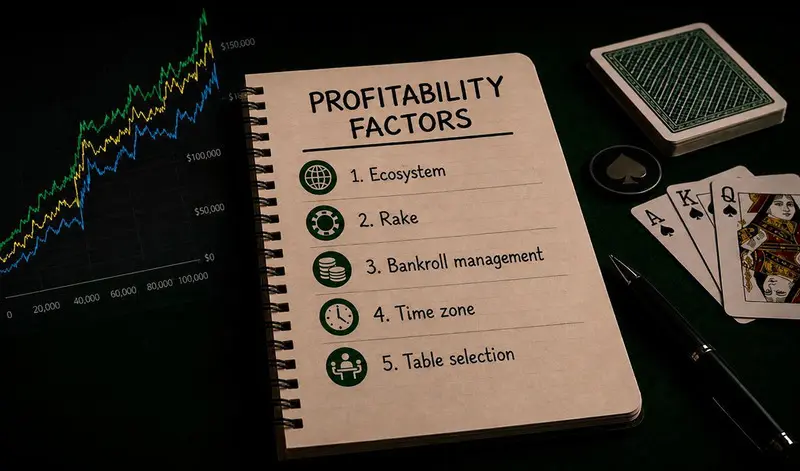
Profitable poker isn't about luck; it's about managing your bankroll effectively. The moment you deposit into your account, you're no longer just playing cards; you're managing capital. To stay profitable over the long term, keep these key principles in mind:
- Poker site ecosystem. Don't rely solely on poker site promotions. Check the affiliates or your friends’ opinion on which poker sites attract more recreational players and which are dominated by regulars. If a player pool is filled with professionals, you won't make any money.
- Rake. The commission eats into your profits. Don't choose a site without first calculating your net margin. By ignoring how rake affects your win rate and bonuses, you'll end up earning money for the poker site instead of yourself.
- Bankroll management. Bankroll is sacred. No matter how good you are, if for some reason you run out of money, you can't continue playing. Maintain strict control—no excuses.
- The right time to play. Launch the poker client when recreational players do. Entering online battles with regular players is financial suicide. Tailor your sessions to the recreational traffic.
- Table Selection. Your job is to analyze the table and answer the question: "Do I have an edge?" If there are no amateurs or weak regulars at the table to exploit, find another table.
- Balance between GTO and exploits. GTO is your standard for avoiding exploitation by opponents and the best strategy against unknown players. But real profit comes from clever exploits, when you gain information about other players' tendencies. Attacking specific vulnerabilities is much more profitable than simply sticking to a balanced strategy.
How to choose a poker site for profitable play
Not all poker sites offer the same terms. How can you distinguish social media hype from genuine offers? Take a look at the table below:
| Parameter | What to pay attention to | Impact on your profits |
|---|---|---|
| Player Pool Composition | The ratio of amateurs to professionals. | Determines your win rate: the higher the percentage of amateurs, the greater the opportunity for exploitation. |
| Game availability | Number of players in your discipline and limit. | If a poker site lacks consistent player traffic, you may struggle to find enough games in your discipline. |
| Rake structure | The commission you actually pay after rakeback has been applied. | Determines your actual expenses on the game and directly impacts your final win rate. |
| Fairness of the game | How effectively the poker site detects bots and prohibited software. | Maintains a healthy poker site ecosystem. Without proper controls, money flows into the pockets of dishonest players. |
| Promotions | Bonuses, leaderboards, and additional rewards. | A valuable tool for boosting your win rate, especially at low stakes, but secondary to the player pool composition. |
Action plan: how to make money playing online poker in 2026
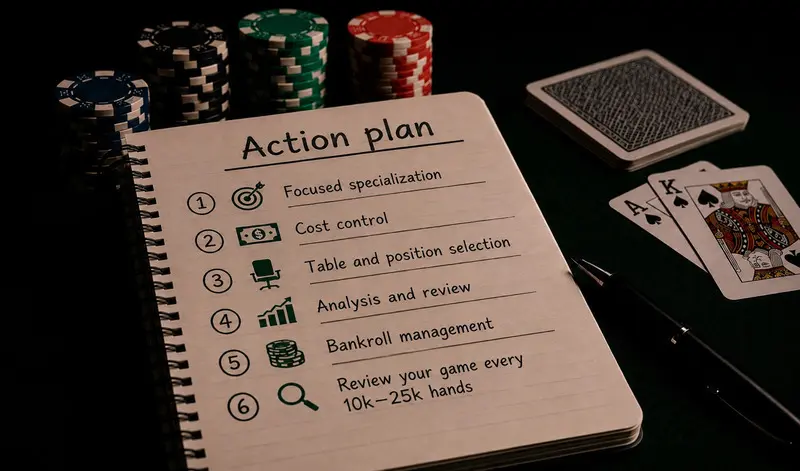
Below are seven steps to help you turn poker into a reliable source of income.
1. Focused specialization (one format, one limit)
Assuming all poker formats are the same is a costly mistake that can hurt your win rate. Cash games, MTTs, and Spins each require a completely different approach—strategy, stack management, and range selection vary significantly between formats. By constantly switching disciplines, you limit your ability to develop true expertise in any one area. Choose a single format and stake level, build a strong database of results, and focus on exploiting recurring weaknesses in your opponents.
In practice, specialization provides three major advantages:
- Identifying player patterns. Rather than dividing your attention across multiple disciplines, you concentrate on one format and notice opportunities that other players miss.
- Long-term analysis. The more hands you play in one format, the more reliable your statistics will be. Without a large enough sample size, any conclusions about player tendencies and required adjustments are just speculation.
- Practical application. A database becomes a real advantage. Against a backdrop of constant improvisation in the player pool, your strategy is built on capitalizing on trends and exploiting the profiles of the regular players you've already studied.
2. Operating cost management (rake and profitability)
Starting at micro-stakes is a sensible approach, but keep in mind that rake takes a much larger percentage of your winnings at these levels. Failing to account for this can significantly reduce your profitability. Don't focus only on finding weak opponents; calculate your actual profitability using this formula:
Net Profit = (Technical Win Rate) − (Rake) + (Rakeback + Bonuses)
To make things clearer, check out the calculations for two different poker sites:
| Poker Site | Technical Win Rate | Rake | Rakeback + Bonus | Total Win Rate (BB/100) |
|---|---|---|---|---|
| A (weak player pool) | 10 BB/100 | −8 BB/100 | +1,6 BB/100 | +3,6 BB/100 |
| B (strong player pool, 50% of rackeback) | −4 BB/100 | −8 BB/100 | +4 BB/100 | −8 BB/100 |
Room B is a classic trap. Even generous rakeback can’t compensate for the losses caused by playing against a stronger field.
Key variables for analyzing the game's profitability:
- Technical win rate. Your win rate before fees are deducted.
- Rake. How much you pay the poker site for playing one postflop hand (cash) or tournament (buy-in in Spins/MTT).
- Rake cap (CAP). The maximum commission for one hand.
- Rakeback and bonuses. A portion of the commission fees that the site returns. This is a nice bonus, not a foundation of your profitability.
3. Table and position selection: your competitive advantage
Table and seat selection can have a major impact on your profitability, yet many players overlook this crucial factor. Your objective is straightforward: find games where you can regularly get involved against recreational players and capitalize on their mistakes.
Features of a weak player:
- High VPIP. A key metric. Players with overly wide opening ranges are easy to exploit—this is the foundation of your win rate.
- Limping Tendency. A tendency to limp indicates a lack of patience and a desire to see as many flops as possible. After all, "I came to play poker, not to fold 80% of the time!" Don't isolate limpers with weak hands that are easily dominated (e.g., Q7s).
- Passivity. Players who avoid aggression and avoid building big pots allow you to control the pot on every street. This allows you to realize more of your equity and extract maximum value from strong hands, including making thinner value bets more frequently.
- Inappropriate Sizing. Bet sizes that don't align with the hand logic or the board structure. Identify these patterns by paying attention to showdowns and exploit them.
- Short stack. A stack of less than 100 big blinds in cash games indicates that the player doesn't have auto-rebuying enabled. Ninety-nine times out of 100, this is a sign of an amateur.
When you identify a player like this, try to take the seat directly to their left. This ensures you’ll have position on them in every hand, allowing you to control pot size, gather more information, and make better decisions. Playing in position makes exploiting their weaknesses significantly easier.
4. At micro limits, a straightforward strategy is better than GTO
Trying to play a perfectly balanced strategy at low stakes is a mistake. Focus on the fundamental aspects of a profitable strategy:
- Use a TAG (tight-aggressive) approach. Play relatively tight ranges and be aggressive with them.
- Position. Use it as your main advantage. Try to act in position as often as possible.
- Focus on getting value. Don't be afraid to "scare your opponent off." Keep slowplaying to a minimum, and save complicated strategy for higher limits. Straightforward value betting is the best approach.
- Minimize bluffing. Avoid bluffing without equity. Against calling stations (loose-passive players), who are common at microstakes, bluffing will only eat into your profits.
- Isolate weak players. Focus on winning pots against amateurs, not regulars.
At low limits, GTO isn't the best choice. Here, winning is based on other players' mistakes, not on balance.
5. Professional approach: calculation and analysis
Poker is a game driven by data. Without tracking your statistics, it’s impossible to identify weaknesses and make meaningful improvements. Your growth should be guided by objective analysis rather than emotions or impressions after a session.
- BB/100. Your actual win in big blinds per 100 hands. This is the main indicator of the profitability of your game.
- EV BB/100. Your theoretically expected win rate. A discrepancy with your actual BB/100 indicates that you're either over- or under-performing in terms of expected value (EV). This helps you understand how much of your results are due to variance.
- Rake Paid. If your win rate is low and your fees are high, it means your tables or strategy aren't profitable.
Game analysis tools:
- Use filters. Don't review every hand. In your tracker, filter for large pots and situations where you regularly lost money.
- Mark problematic hands. During your session, note any hand that made you doubtful or unsure. These are the keys to your progress.
- Use third-party software. Use trackers and HUDs only where permitted by the poker site's terms. If software is prohibited, observation and note-taking become your primary tools.
Important: If you find yourself in the same losing situation over and over again and don't change anything, it's not a variance, but a systemic problem.
6. Bankroll management and psychological control
Poker is a business where bankroll management and discipline are your most important tools. Without a clear strategy and financial plan, even the most skilled players can lose everything.
Bankroll management
Your bankroll should be completely separated from your personal finances. If losing a single stack makes you anxious, you don't have enough funds for the limit you're playing at.
There are two approaches to bankroll management—choose the one that's most suitable for you:
- Static approach. Keep around 50 buy-ins if you play cash games. If you prefer MTTs, your bankroll should be larger: 100-200 buy-ins, as tournament variance is significantly higher. These are classic recommendations for low and mid-stakes.
- Dynamic approach. Adjust your bankroll based on your win rate and the level of the player pool. The higher the stakes, the tougher the competition becomes, so increase your buy-in reserve and never move up a limit without a proven positive win rate. Jumping to a new limit without a technical advantage means becoming an easy target for stronger regular players.
If your bankroll falls to the minimum level required for your current stakes, move down immediately. Dropping limits is not a sign of failure—it’s a smart decision to protect your bankroll and preserve your ability to keep playing.
Psychological control
Without discipline, even the best strategy will fail. Remember these three rules to prevent tilt from ruining your career:
- Don't try to win back your losses. The thought "I'll get it all back today" is the most costly and destructive mistake in poker. Consider the losses as an operating expense.
- Set a loss limit for the session. If you reach it, turn off the client. You can always return to the tables the next day, but with a clear mind and a positive mindset.
- Monitor your well-being. Play only when you're in good shape. If you're tired, stressed, or worried about something, don't open the tables. Profits depend on the quality of your decisions, not the number of hours.
7. Analyze your game every 10,000 to 25,000 hands
Poker should be evaluated over large samples, not by individual session results. Without regularly analyzing your database, you're playing blind.
- Initial analysis (10,000 hands). This sample won't confirm your win rate, but it's the perfect time to correct basic mistakes. Filter for common situations (for example, continuation bets on A-high boards or 3-bets on the big blind) and check whether you're making the right decisions and not operating on autopilot. The goal isn't to see how much you've won, but to ensure your play matches what you've learned away from the tables.
- In-depth analysis (25-50,000 hands). At this stage, you can already identify recurring patterns. Identify the spots where you consistently lose money and review them using optimal strategy as a benchmark. Drawing definitive conclusions about your true win rate requires a larger sample; however, even a basic analysis at this stage can help you eliminate major weaknesses in your game.
- Professional approach. If you're not happy with your results, don't blame the poker site's random number generator or attribute your failures solely to variance. Review your workflow:
- ❓ Table Selection. Are you playing against profitable players or players who can be exploited?
- ❓ Rake Impact. Is your strategy viable given the fees at your current limit?
- ❓ Tilt Control. Did your discipline fail you during the session?
- ❓ Recurring Mistakes. Are you making the same mistakes over and over again due to carelessness?
Risks, bots, and fair play

The reliability of a poker site directly impacts your results. Even the best strategy is meaningless if the platform lacks proper security or fails to process withdrawals reliably.
Let's look at the key risks and how to protect against them:
- Bots, collusion, and the use of prohibited software (such as real-time assistance, RTA) significantly reduce your profits. If a site doesn't monitor table integrity, your win rate will inevitably suffer.
- When choosing a poker site, don't take licenses as a guarantee—they're just a formality. Choose sites with high traffic, an impeccable reputation, and good reviews from affiliates and other players.
- Warning signs: Unresponsive support or delayed withdrawals are signs of possible financial difficulties. If you notice this, withdraw your funds immediately.
- Don't use prohibited software. In addition to being banned and having your funds confiscated, it hinders your growth as a player.
- Report violations. If you notice suspicious patterns, submit a complaint to support with specific details. Avoid discussing your suspicions on social media—the site may block you for defamation.
Important: Keep only the amount needed for your current playing volume in your poker account. Withdraw the rest.
Mistakes that prevent you from making money online

The gap between professionals and amateurs is not always defined by technical knowledge alone. Often, it comes down to the ability to avoid invisible operational errors. If you don't control these factors, you systematically sabotage your success.
- Overestimating your skill. Confusing a successful streak with skill is a costly mistake. Without analyzing your game using a solid statistical sample, you assume an edge that doesn't actually exist. When variance normalizes, a lack of technical skill and irresponsible bankroll management will ruin your game.
- Playing on autopilot. Acting mechanically, without assessing table dynamics and adapting to your opponents, means destroying your edge. Poker requires active and conscious decision-making on every street.
- Excessive multi-tabling. Playing more tables than you can manage limits your analytical ability. Prioritizing volume over quality forces you to simplify your strategy and reduces your win rate. Know your limits: exceeding them leads to mistakes that negate your mathematical advantage and destroy your profits.
- Ignoring the impact of rake. Not considering the commission the poker site takes is a fundamental financial mistake. Neglecting table selection. Sitting down at the first table you come across is for recreational players. Your profits directly depend on your ability to find tables where you have the edge.
- Tilt. Allowing frustration, bad luck, or emotion to influence your strategy means burning through entire stacks. Tilt clouds your rational understanding of poker and turns a bad day into a financial disaster.
- Playing beyond your bankroll. Playing sessions at limits you can't afford is a guaranteed path to ruin. Variance will eventually destroy anyone without a safety net.
- The illusion of a small sample size. Drawing conclusions based on short-term results is self-delusion. Only a large hand volume will reveal whether your strategy is truly profitable or just a fluke.
- Lack of specialization. Constantly jumping between disciplines (spins, cash, MTTs) prevents you from mastering any of them at a high level. To be profitable, you need to choose one discipline and become an expert in it.
Bottom line: what it takes to win at online poker in 2026
The days of "easy money" before Black Friday are long gone. Today, a positive win rate requires discipline and a rigorous approach:
- ☝️ Those who manage every aspect of the game have an advantage. Success comes to those who approach the game wisely: choosing tables, considering the impact of rake, maximizing rakeback, practicing bankroll management, and constantly learning.
- ☝️ Progress gradually through the limits. Start at low limits. Patiently build your bankroll and evaluate results only over the long term.
- ☝️ Have a professional mindset. Poker is not a hobby. Treat it like a business: your job is to make the best possible decisions under uncertainty, not judge your performance based on the results of a single session. Your goal is long-term profit, not quick cash.
It's up to you to decide: to stay an amateur who constantly gives away chips, or become a professional who knows how to take advantage of opportunities.


Lying in the south of the Balkans, Greece (or Ελλάδα in Greek),...
Germany legalized online poker in July 2021. Playing online is fully legal, and exactly five oper...
Australia banned online poker for operators but not for players. That one distinction is why, alm...
Online poker in Thailand sits in a legal grey zone that got darker in 2025. Under the Gambling Ac...