



- Home
- Latest poker news
- Poker Bankroll Management: Complete Guide for Beginners
Poker Bankroll Management: Complete Guide for Beginners
Poker bankroll management is a system for managing your funds that helps control risk, handle variance, and avoid going broke over the long run. Without proper bankroll discipline, even strong players can experience significant losses during downswings. Understanding bankroll management is not just an optional skill — it’s a core part of long-term success in poker.
Almost every poker player has encountered an unpleasant paradox: you play well, follow your plan precisely, and make the right decisions, but your account balance is still going down. Sometimes these downswings are so severe that you simply run out of money for the game. This is because, in poker, short-term results don’t always reflect the quality of your play. Even if you have an edge over the field, it doesn’t show up right away—it materializes over a large number of hands. And before that happens, you have to endure downstreaks, coolers, and the usual fluctuations in variance.
That's why in poker, it's not just your skill level that matters, but also how you manage your money, i.e., bankroll management. Check out this guide, as we'll explore this term in detail, explain how many buy-ins are needed for different game formats, what determines bankroll requirements, and explain how to assess the risk of ruin and navigate the limits correctly. After reading this article, you’ll have more than just general advice; you’ll gain a structured approach you can apply to your own game to minimize the risk of losing your bankroll, even during extended downswings.
What is bankroll management in poker and why is it important?
Bankroll management is the foundation of any long-term game. It's not about "playing it safe," but about ensuring your skills can be fully applied in real-world situations. Without proper bankroll management, even a profitable player can lose money because of variance. With the right approach, you reduce the risk of ruin, handle downstreaks more comfortably, and make decisions without the undue pressure of money.
Bankroll and risk of ruin
A bankroll is the portion of money set aside exclusively for poker. It’s not your total income or general funds, but dedicated capital meant to support your game. Its role is to absorb inevitable downswings and keep you in the game long enough for your edge to show over time.
Risk of ruin refers to the likelihood of losing your entire bankroll over the long run, even if you’re a winning player. The key idea is simple: in poker, losing money is never impossible. It’s a matter of probability, which increases or decreases depending on how well you manage your bankroll.
Simply put:
- Small bankroll → high risk of ruin.
- Large bankroll → low risk of ruin.
Why even a winning player can go bankrupt
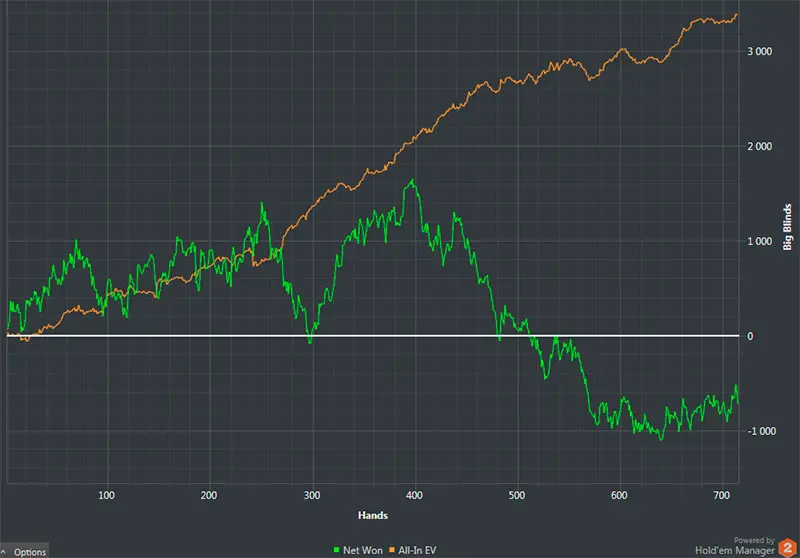
The main reason is variance. Variance is the natural fluctuations in your results relative to your actual win rate. Even if you consistently make winning decisions, you can still lose in the short-term perspective, and for quite a long time.
Downstreaks are a practical manifestation of variance. These are periods when:
- You don’t get playable hands.
- You lose on showdowns.
- Coolers are coming one after another.
This sn’t an exception—it’s the reality of poker.
The problem starts when a player makes a common mistake: "I’m beating this limit so I can move up." At that point, variance is ignored, and players begin taking shots at higher stakes without a sufficient bankroll. In the short term, things may go well, but a single prolonged downstreak and the bankroll simply can't handle it.
That’s why success in poker isn’t just about winning; it’s also about being able to withstand the periods when you're losing, playing correctly.
Separating bankroll and personal finances in poker
The most common mistake is mixing your bankroll with your living expenses. When it happens, any fluctuations in your game start to impact your daily decisions: expenses, stress, and pressure at the tables.
The correct approach is a strict separation:
- A bankroll is money for playing.
- A personal budget is money for living.
- A reserve is a financial safety net kept separate from poker funds.
If you've lost part of your bankroll, it shouldn't change your life. Conversely, if you need money for expenses, it shouldn't be borrowed from your bankroll.
In practice, it looks like this:
- A fixed amount is allocated for the game.
- If necessary, cashouts are made only from profits.
- There is a separate reserve that is independent of poker.
This approach reduces pressure and lets you make decisions based on EV, rather than worrying about losing your "last money."
How many buy-ins are required for different formats?

The number of buy-ins in a bankroll depends on the format, discipline, and playing style. In more evenly matched games, a smaller bankroll may be sufficient. Where results depend on coolers, multipliers, or rare deep runs, a significantly larger bankroll is required.
It's important to understand: there's no one-size-fits-all formula for bankroll management. For the same format, you may find more aggressive or more conservative recommendations, depending on your win rate, discipline, and willingness to drop limits. Therefore, when studying the tables below, we recommend focusing on working ranges rather than specific numbers.
| Discipline | Aggressive | Standard | Conservative |
|---|---|---|---|
| NLHE | 30–40 BI | 40–60 BI | 70–100 BI |
| PLO | 50–70 BI | 70–100 BI | 100–150 BI |
| Short Deck (6+) | 50–80 BI | 80–120 BI | 120–200 BI |
The ranges in the cash game table are based on a player’s risk tolerance. The aggressive approach suits players comfortable with a smaller bankroll who are ready to move down in the limits quickly during downstreaks. The standard range serves as a solid baseline for most players. The conservative approach provides a larger safety cushion and is better suited for players with an uncertain win rate, high rake, or low tolerance for variance.
| Tournament Type | Recommended Bankroll |
|---|---|
| Freezeouts (Small/Medium Fields) | 100–150 BI |
| Freezeouts (Large Fields) | 150–300 BI |
| Re-entry / Rebuy | 150–300 BI |
| PKO / Bounty | 120–250 BI |
| Turbo / Hyper MTT | 200–400 BI |
| Format | Recommended Bankroll |
|---|---|
| Classic SNG | 50–100 BI |
| Turbo SNG | 80–150 BI |
| Hyper SNG | 100–200 BI |
| Spin / Jackpot | 150–300 BI |
| AoF | 150–300 BI |
Use the tables as follows: if you're confident in your skill level, disciplined, and willing to strictly control your limits, you can move closer to the lower end of the range. If you have doubts about your win rate, are playing inconsistently, or simply want to reduce risk, it's wiser to stick to the middle or upper spots of the ranges.
What does bankroll depend on: key parameters
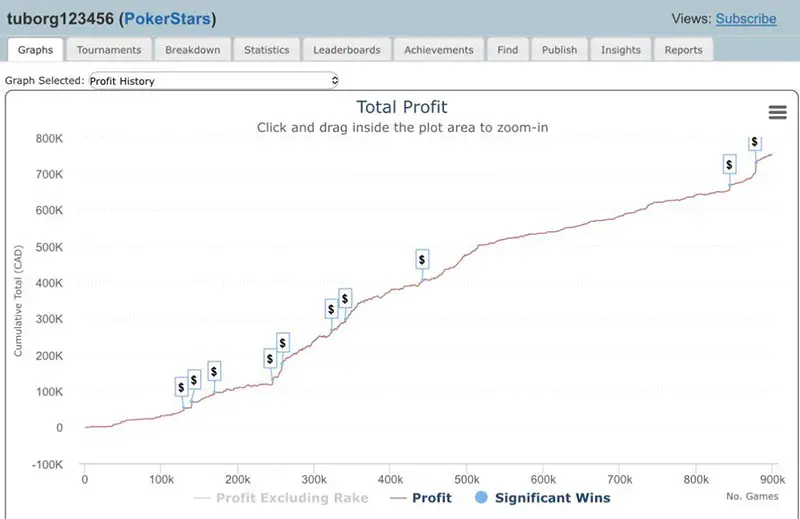
The number of buy-ins isn’t just a fixed number from a chart—it depends on several key variables. The same bankroll can be sufficient for one player and inadequate for another. Three factors matter most: your actual win rate, the level of variance, and the volume of play.
Winrate and variance in poker: how they affect your bankroll
Winrate (BB/100) is your average win rate, measured in big blinds per 100 hands. Simply put, it's a measure of how well you beat the field. For example, 5 BB/100 means you win, on average, 5 big blinds for every 100 hands played.
But winrate alone doesn't guarantee anything. It's also important to consider a second metric, standard deviation (SD). It shows how far your results can deviate from your average over time. In poker, SD is usually much higher than your winrate, so even winning players can experience prolonged downstreaks.
Key points:
- High win rate → easier to survive drawdowns.
- High variance → wider spread of results.
- Low win rate + high variance → worst-case scenario.
It's the combination of these two metrics that determines bankroll requirements. A player with a win rate of 8 BB/100 and moderate variance can comfortably play with 40-50 BI. A player with 2-3 BB/100 with the same variance is already in the high-risk zone and requires a deeper bankroll.
Therefore, the ranges given in the previous chapter are only average guidelines. In reality, effective bankroll management is always tied to your win rate and the variance of your results.
Rake and rakeback: impact on your poker bankroll
Rake directly reduces your win rate. This isn't just a nuisance, but one of the main reasons why players often overestimate their bankroll safety margins.
It's important to understand: rake doesn't increase variance per se, but it does reduce your actual profit, which means it worsens the balance between your win rate and the variance in your results.
A simple example:
- Without rake, you could play at a win rate of 6 BB/100.
- With rake, it drops to 2-3 BB/100.
Technically, you're still a winning player, but your bankroll in this situation becomes much less stable. The same bankroll is less able to withstand downstreaks, and the risk of ruin increases significantly.
Rakeback partially offsets this impact, but its importance shouldn't be overestimated. In many cases, it simply returns part of what was already lost to rake rather than providing additional profit.
Hence, the practical conclusion: the higher the rake and the lower your net win rate, the larger bankroll is required.
Volume and long-term game
One of the most common mistakes is drawing conclusions based on short-term results. A small upstreak can easily create the impression that you're confidently beating the limit, while a downstreak can create the impression that you're not playing well enough. In reality, over a short period of time, results are almost always determined by variance, not by skill.
For cash games, this can be represented as follows:
- 10-20,000 hands—the result may still be random.
- 50-100,000 hands—general trends can already be seen, but conclusions should still be made with caution.
- 100,000 hands and more—the sample size becomes significantly more reliable for estimating win rates, although there is still a margin of error.
The sample size has a direct impact on your bankroll. If you overestimate your win rate and take a more aggressive approach, your risk of ruin rises sharply. Your bankroll should reflect your true level of play, not a short-term upstreak.
A simple rule follows: if your sample size is small and your win rate isn’t yet proven, your bankroll should be larger, not smaller.
Limit move rules: when to move up and when to move down
No bankroll management (BRM) advice will be effective if a player doesn't follow the rules for moving between limits. BRM isn't about how many buy-ins to hold, but rather how to react to bankroll growth and decline. Mistakes here are the most costly: it's inappropriate transitions between limits that most often lead to bankroll loss.
Basic principle: play according to your bankroll
The main rule of effective bankroll management: the current limit should correspond to the size of your bankroll, not your desires or ambitions. You choose a stakes level that your bankroll can actually handle, and don't try to stay higher just because you're more accustomed or comfortable there.
A typical mistake: a player moves up a limit, plays there for a while, and begins to consider it "his limit." After a drawdown, they refuse to go down because they've become psychologically attached to that level. At that point, BRM stops being effective.
When to move up in limits
The transition to the next limit should not occur based on feelings, but after meeting certain conditions:
- You've built a sufficient bankroll for the current limit.
- You clearly understand that you're beating the current limit.
But even if these conditions are met, you need to move up carefully. Taking a shot at a higher limit—testing it with controlled risk—can help you adjust more safely.
What it looks like:
- Set aside a portion of your bankroll (for example, 5-10 buy-ins) for playing at a higher limit.
- If you lose this portion, you return to your previous limit.
- If all goes well, you gradually consolidate your position.
The key point: a trial run to the next limit is a controlled risk, not a full-blown transition. If you immediately start playing a new limit "all in," it's no longer BRM.
When is it necessary to move down the limit?
Dropping to a lower limit isn't a sign of weakness, but rather a key way to protect your bankroll.
The indicators that you should move down have to be clear and predetermined. For example:
- You've lost the pre-determined margin at this limit—for example, the 5-10 buy-ins you set aside to move up.
- Your bankroll has dropped below the amount required for this limit, meaning you're forced to play lower by your own rules.
- Your play has deteriorated—you're prone to tilt, making frequent mistakes, and making bad decisions.
The most dangerous situation is when a player refuses to lower their limit, hoping to "fight back." This is a classic scenario that almost always ends in a serious drawdown or complete ruin.
The correct way to move down a limit:
- It happens quickly.
- Without trying to "squeeze just a little bit more."
- It is considered a normal part of poker development.
Control of emotions

Even with the right bankroll and clear rules for transitions, emotions can still ruin everything.
One effective way to control your losses is to predetermine at what point you'll end a session or take a break. This helps you stop before tilt begins to influence your decisions.
Why this is important:
- After a series of losses, the quality of play declines.
- Decisions become impulsive.
- The player begins to deviate from the strategy.
As a result, players don’t just lose because of variance; they compound their losses through poor decisions.
Tilt is closely tied to bankroll size. The smaller the bankroll, the higher the psychological pressure, and the quicker emotional decisions take over. In contrast, a well-funded bankroll reduces stress and supports more consistent play.
Bankroll management isn’t only about numbers; it’s also about self-control. Even experienced regulars can lose money when emotions take over, while a beginner with solid discipline can steadily move up the stakes despite making technical mistakes.
Tracking results: how to monitor your bankroll
Bankroll management is impossible without taking results into account. If you don't know your true win rate, understand the impact of rake, and don't track your game dynamics, any decisions related to moving up stakes become guesswork.
The mistake most players make is focusing on account balances or short periods of time. But a bankroll isn't just a sum of money; it's a reflection of your long-term play. To make informed decisions, you need to know certain statistics.
What stats should be tracked?
There is a core set of statistics that’s essential for objectively assessing your game and managing your bankroll effectively.
| 📊 Statistics | 👀 What it demonstrates | ❗Why it's important |
|---|---|---|
| 🏆 Winrate (BB/100) | Average profit over the sample size | It helps to determine whether you’re truly beating the limit and whether your bankroll can realistically be considered sufficient for play. |
| 🎲 EV (All-in EV) | The expected result of a bet without factoring in luck | Allows to determine whether a decrease in win rate is due to bad luck or a deterioration in the quality of play |
| 💰 Rake | How much money goes to the room | Demonstrates how much commission is cutting into your win rate and whether a larger bankroll is required |
| 💵 Profit (in BI) | Changing bankroll in buy-ins | Helps evaluate drawdowns and growth in a clear manner, without being tied to a specific limit |
| 🔢 Number of hands/tournaments | Sample size | Helps to understand whether you can trust the current results or if it is too early to draw conclusions. |
Tools and approach
Keeping track of things in your head or by checking your account balance is a bad idea. A system is required.
The main tool is trackers:
- Automatically collect statistics.
- Allows you to see winrate, EV, and variance.
- Provides access to the hands database.
But a tracker alone won't solve anything if there's no discipline. Important:
- Regularly analyze your results.
- Don't draw conclusions based on short-term results.
- Monitor not only your profits, but also your game performance.
Additionally, many players keep a simple table:
- Current bankroll.
- Limits.
- Downstreaks and upstreaks.
- Decisions on moving between limits.
This helps you understand the bigger picture, not just the raw tracker stats.
The key idea: tracking isn’t a formality, it’s a control tool. Without it, bankroll management turns into guesswork rather than a structured system.
FAQ
The state that raised 2025 WSOP Main Event champion Michael Mizrachi still refuses to regulate on...
Britney “AlllinBritney” Jing will not be appearing on the popular poker live stream s...
Phenom Poker is launching the Phenom Poker of Series (PSOP), its inaugural tournament series, boa...
GGPoker will award a total of $18,000,000 during its 2026 October Giveaway series. In addition to...