



- Home
- Latest poker news
- Jaime Staples Aims to Create a New Platform as an Alternative to Twitch and YouTube
Jaime Staples Aims to Create a New Platform as an Alternative to Twitch and YouTube
Popular streamer and poker pro Jaime Staples has expressed interest in building his own platform for poker videos and live streams to bypass restrictions imposed by Twitch and YouTube. He has also invited other colleagues in the industry to join the discussion and explore the possibility of launching a new site together.
Staples' Plan: a platform without blockings and algorithms
Jaime Staples is a professional poker player best known for his streams on Twitch. He has built a large community, with thousands of subscribers and more than 2,600 videos on YouTube. The Canadian has been streaming consistently for over a decade.
In mid-March 2026, Jaime Staples spoke on social media about launching a dedicated platform for poker content, aiming to solve the ongoing issue of blocks and restrictions imposed by major services.
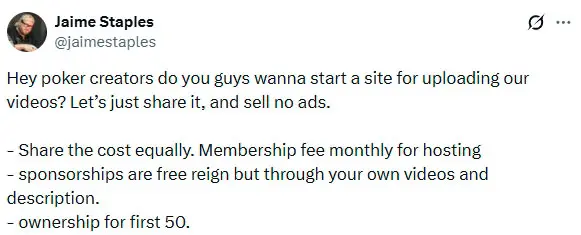
The key elements of his proposal include:
- Content creators manage monetization and sponsorship integrations themselves.
- Hosting and platform development costs are shared among participants.
- Intrusive advertising and algorithmic restrictions are eliminated.
For now, Jamie invites everyone to discuss how to implement the new project.
Why are poker videos blocked?
Poker streamers and vloggers have long struggled with the algorithms of major platforms treating poker content as gambling. This results in videos being less frequently recommended and sometimes even being removed.
Jamie Staples has personally experienced this problem. In 2020, he received a strike from YouTube, and over 100 videos were deleted from his channel. It had a significant impact on his monetization and audience outreach.
The platform stated that the reason for the incident was a violation of rules related to the "sale of regulated merchandise," including links to poker sites, even though many videos did not directly promote gambling. Staples and other streamers were able to restore several channels and videos. However, no one can guarantee that this situation will not recur in the future.
As a result, not only do the content creators suffer, but viewers also lose out, who can often only find the videos they require via direct links.
What challenges would stand in the way of competing with YouTube and Twitch?
For now, Staples' proposal is more of an idea for discussion than a finished project. There are several serious obstacles to its implementation:
- Technical and legal issues – it is necessary to develop a website from scratch, resolve issues with hosting, licensing, security, and payment methods.
- No audience – attracting users to a new website is much more difficult than retaining them on established platforms.
- Monetization – without a well-defined revenue model, the platform may struggle to remain profitable, particularly in the absence of advertising.
- The core issue is regulation. There’s a reason YouTube limits poker content: platforms must comply with laws across multiple jurisdictions covering gambling, advertising, and the protection of minors.
If Jaime Staples’ proposed platform draws the attention of regulators, it will likely have to introduce similar restrictions. In addition, alternatives such as Kick and Trovo already exist, yet neither has managed to seriously challenge YouTube or Twitch.
A more practical path for the growth of poker video content may be to adapt to the rules of major platforms while encouraging poker rooms to take a more active role in supporting and promoting streams and videos.
The state that raised 2025 WSOP Main Event champion Michael Mizrachi still refuses to regulate on...
Britney “AlllinBritney” Jing will not be appearing on the popular poker live stream s...
Phenom Poker is launching the Phenom Poker of Series (PSOP), its inaugural tournament series, boa...
GGPoker will award a total of $18,000,000 during its 2026 October Giveaway series. In addition to...