



- Home
- Latest poker news
- 10 Years of Triton Poker: Anniversary Statistics for the Premier High Roller Series
10 Years of Triton Poker: Anniversary Statistics for the Premier High Roller Series
Over the past decade, Triton Poker has evolved from a niche project for high-stakes players into a globally recognized brand and the world's premier high roller series. During that time, Triton events have awarded nearly $2 billion in prize money. To mark the anniversary, MTT DB analysts prepared an in-depth study exploring not only player performances but also the evolution and growth of the series itself.
Ten years ago, Paul Phua and Richard Yong founded Triton Poker, likely without imagining what their creation would eventually become. What began as a series of high-stakes tournaments for a small group of players has grown into a global brand and a name synonymous with tournament poker with the highest buy-ins.
Today, Triton Poker festivals bring together the world's top professionals and elite high-stakes players several times a year. Over the past decade, the series has awarded more than $1.8 billion in prize money. To celebrate Triton's anniversary, MTT DB analysts have prepared a comprehensive study that explores the brand's history through statistics, player performances, and real ROI figures.
From a private club to a global empire
In ten years, Triton has grown from a small project for high rollers to a major poker brand in the six-figure buy-in tournament segment. By the start of the 2026 anniversary season, more than 270 players will have earned at least $1 million in the series' tournaments.
- 💰 $1.88 billion in prize money
- 🏆 303 tournaments
- 🎟️ 37,115 entries, including re-entries
- 👥 Around 2,000 unique players
- 🌎 Players from 87 countries have participated in the series
- 🔄 40.1% of registrations were re-entries
Statistics by year
| Year | Events | Entries | Players | Countries | Avg field | Avg cost/entry | Prize money |
|---|---|---|---|---|---|---|---|
| 2016 | 4 | 188 | 23 | 11 | 47 | $93,356 | $11.3M |
| 2017 | 6 | 345 | 43 | 17 | 58 | $57,236 | $3.3M |
| 2018 | 11 | 597 | 80 | 22 | 54 | $97,893 | $55.4M |
| 2019 | 30 | 1,974 | 198 | 39 | 66 | $117,753 | $230.0M |
| 2022 | 29 | 1,966 | 207 | 53 | 68 | $67,780 | $126.5M |
| 2023 | 55 | 5,318 | 453 | 67 | 97 | $60,324 | $305.6M |
| 2024 | 47 | 6,069 | 434 | 64 | 129 | $68,955 | $395.8M |
| 2025 | 67 | 11,330 | 999 | 72 | 169 | $47,476 | $512.9M |
| 2026 | 54 | 9,328 | 936 | 63 | 173 | $27,255 | $243.4M |
Average field sizes have grown from just a few dozen players in the early years to around 170 entries per tournament today. At the same time, the average buy-in has declined considerably, falling from the typical $90,000-$120,000 range to approximately $27,000.
The introduction of Triton ONE has been the primary driver behind these changes. By adding tournaments with more affordable buy-ins, the series has attracted a much broader player base. The numbers clearly demonstrate the success of this strategy: at the time of writing, 2025 stands as the most successful year in Triton's history in terms of attendance and overall series scale.
Moreover, the series' growth potential remains far from exhausted. Although 2026 is still ongoing at the time of publication, the results from the first six months already indicate that the it could surpass the achievements of its previous record-breaking season.
Buy-in statistics
| Buy-in tier | Events | Entries | Avg field | ITM% | Prize money |
|---|---|---|---|---|---|
| Under $25K | 45 | 11,703 | 260 | 15.60% | $94.7M |
| $25K–50K | 103 | 11,307 | 110 | 16.00% | $324.5M |
| $50K–100K | 79 | 6,392 | 81 | 15.80% | $354.3M |
| $100K–250K | 70 | 7,209 | 103 | 16.00% | $905.3M |
| $250K and up | 6 | 504 | 84 | 17.10% | $205.2M |
Of the 303 tournaments included in the study, the vast majority were Hold'em events—256 in total, including Short Deck tournaments. The remaining 47 events were played under PLO rules.
The prize distribution highlights the importance of the highest-stakes events within the Triton ecosystem. Just six tournaments with the largest buy-ins, representing roughly 2% of the entire schedule, generated $206 million in prize money.
At the same time, the largest share of payouts came from events with buy-ins ranging from $100K–250K: This category accounted for approximately half of all prize money awarded during Triton Poker's first ten years.
The largest tournaments
| # | Event | Year | Field | Prize pool |
|---|---|---|---|---|
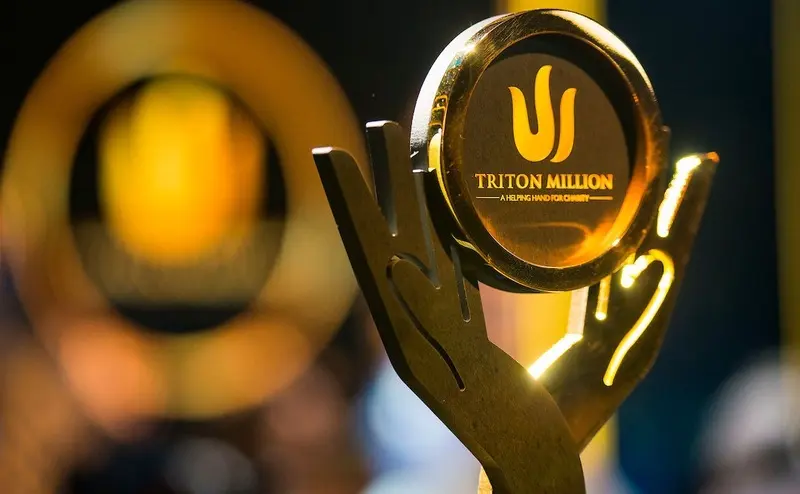
| 1 | Triton Million for Charity — London | 2019 | 54 | $68.89M |
| 2 | Triton Million — Paradise | 2024 | 96 | $48.00M |
| 3 | $250K NLH Invitational — Paradise | 2025 | 133 | $33.25M |
| 4 | $250K NLH Luxon Invitational — London | 2023 | 118 | $29.50M |
| 5 | $100K NLH Main Event — Jeju | 2025 | 285 | $28.50M |
| 6 | $200K Triton Invitational — Montenegro | 2026 | 137 | $27.40M |
| 7 | $200K NLH Invitational — Montenegro | 2025 | 133 | $26.60M |
| 8 | $100K NLH Main Event — Paradise | 2025 | 237 | $23.70M |
| 9 | $200K NLH Coin Rivet Invitational — Cyprus | 2022 | 115 | $23.00M |
| 10 | $100K NLH Main Event — Jeju II | 2025 | 228 | $22.80M |
The record-breakers for the number of entries were the cheaper Triton ONE tournaments held in Jeju over the past year and a half:
- $3K QQPK Genesis 2026 — 1,236 entries
- $8K Main Event 2026 — 1,230 entries
- $3K QQPK Genesis 2025 — 1,185 entries
- $8K Main Event 2025 — 1,046 entries
- $5K NLH Mystery Bounty — 836 entries
Triton Poker players
An analysis of the results of players who participated in at least three Triton Poker tournaments from 2016 to 2026 shows how difficult it is to stay profitable when playing high-stakes events:
- 1,233 players participated in at least three Triton Poker tournaments.
- 347 of them won (28%).
- Just 1% of the most successful players accounted for 28.8% of all winnings in the series.
- The top 10% received 86.4% of the total prize money.
The statistics show that nearly three-quarters of the series' regular participants are losing players. These figures are based solely on tournament results and do not account for additional expenses such as travel, accommodation, commissions, or backing.
The distribution of winnings is even more revealing. A significant portion of Triton Poker's prize money is concentrated among a relatively small group of highly successful players.
This naturally leads to an important question: who are the selected winners consistently profiting from the biggest tournaments, and who is responsible for the cash flow?
Top players

The top 10 in terms of prize money are:
| # | Player | Earnings | Cashes | Wins | FTs | Net P&L | ROI | Career | Biggest Cash |
|---|---|---|---|---|---|---|---|---|---|
| 1 | Bryn Kenney | $50.37M | 26 | 5 | 13 | +$37.36M | +287% | 2016–2026 | $21.55M (£1.05M Triton Million for Charity 2019) |
| 2 | Jason Koon | $40.61M | 81 | 12 | 43 | +$12.28M | +43% | 2018–2026 | $3.59M (1M HKD Short Deck Ante-Only 2018) |
| 3 | Stephen Chidwick | $33.81M | 77 | 3 | 42 | +$3.35M | +11% | 2017–2026 | $5.63M (£1.05M Triton Million for Charity 2019) |
| 4 | Dan Dvoress | $32.86M | 76 | 6 | 45 | +$3.09M | +10% | 2017–2026 | $4.39M (Triton Million 2024) |
| 5 | Mikita Badziakouski | $31.75M | 59 | 5 | 31 | +$6.29M | +25% | 2017–2026 | $5.26M (2M HKD Main Event 2018) |
| 6 | Danny Tang | $30.93M | 70 | 6 | 39 | +$4.18M | +16% | 2019–2026 | $3.52M ($100K NLH Main Event 2026) |
| 7 | Aleks Poņakovs | $29.72M | 40 | 2 | 23 | +$13.73M | +86% | 2022–2026 | $4.75M ($100K NLH Main Event 2025) |
| 8 | Punnat Punsri | $29.32M | 53 | 6 | 27 | +$11.45M | +64% | 2022–2026 | $3.11M ($250K NLH Luxon Invitational 2023) |
| 9 | Paul Phua | $26.25M | 60 | 2 | 32 | +$458K | +2% | 2016–2026 | $3.26M (£100K NLH Main Event 2019) |
| 10 | Dan Smith | $26.23M | 38 | 2 | 15 | +$13.27M | +103% | 2017–2026 | $9.19M (£1.05M Triton Million for Charity 2019) |
To be fair, Bryn Kenney earned first place due to his £1.05 million win in the 2019 Triton Million for Charity, winning $21.55 million. Dan Smith earned the second-largest prize, $9.19 million. Most tournaments have a best-cash of no more than $5.6 million.
The leaderboard by winnings shows who has earned the most, but the ROI rankings show who has truly played effectively over the long term.
Bryn Kenney, with an ROI of about +262%, and Dan Smith, with an ROI of about +101%, look impressive, but they achieved these figures thanks to a single, particularly large win in the same charity tournament.
Removing the effect of a single win, Alexey Ponyakov leads Triton by ROI: an ROI of about +86% with a net profit of $13.73 million and prize money of $29.72 million. It is he who demonstrates the most even and stable results over the long-term play.
Who lost the most?
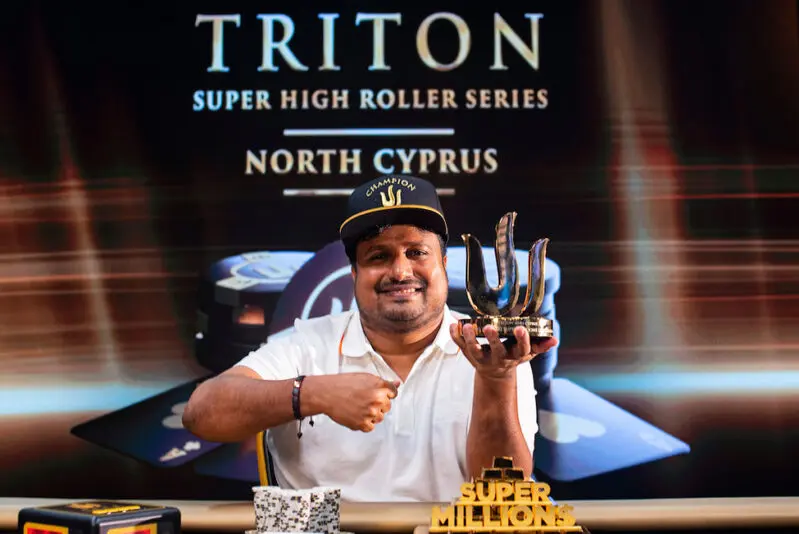
Top 10 players with the biggest losses on Triton:
| # | Player | Earnings | Cashes | Wins | FTs | Net P&L | ROI | Career | Biggest Cash |
|---|---|---|---|---|---|---|---|---|---|
| 1 | Santhosh Suvarna | $11.29M | 36 | 1 | 13 | −$12.28M | −52% | 2022–2026 | $2.14M ($100K NLH Main Event 2025) |
| 2 | Nick Petrangelo | $8.33M | 26 | 1 | 11 | −$9.17M | −52% | 2023–2026 | $1.17M ($250K NLH Luxon Invitational 2023) |
| 3 | Isaac Haxton | $23.10M | 76 | 1 | 45 | −$7.72M | −25% | 2017–2026 | $2.79M ($100K PLO Main Event 2025) |
| 4 | Ferdinand Putra | $2.00M | 10 | 0 | 4 | −$7.29M | −78% | 2022–2025 | $598K ($100K Short Deck 2025) |
| 5 | Artur Martirosian | $15.53M | 55 | 5 | 20 | −$6.15M | −28% | 2022–2026 | $2.64M ($100K NLH Main Event 2025) |
| 6 | Orpen Kisacikoglu | $9.49M | 28 | 2 | 6 | −$5.88M | −38% | 2019–2026 | $2.12M (€100K NLH Main Event 2022) |
| 7 | Michael Soyza | $14.94M | 36 | 2 | 19 | −$5.47M | −26% | 2019–2026 | $2.31M ($100K NLH 8-Handed 2024) |
| 8 | Chris Brewer | $10.34M | 34 | 2 | 15 | −$5.38M | −34% | 2022–2025 | $1.45M ($125K NLH Main Event 2023) |
| 9 | Poseidon Ho | $1.83M | 13 | 0 | 3 | −$5.06M | −73% | 2025–2026 | $368K ($50K NLH 7-Handed 2025) |
| 10 | Ding Biao | $16.29M | 46 | 3 | 21 | −$5.04M | −24% | 2023–2026 | $2.87M ($150K NLH 8-Handed 2024) |
An analysis of this list shows that the reasons for large negative results among players vary significantly, even if the final figure looks roughly the same.
- Santosh Suvarna often chooses the series' biggest tournaments, but rarely cashes.
- Isaac Haxton plays a wide range of events and actively re-enters.
- Nick Petrangelo's situation is different: his loss is largely due to a prolonged downstreak.
The series' biggest losers are roughly evenly split between amateurs and top-level professionals. For amateurs, negative results are more often due to trying to play tournaments at too high a level with insufficient long-term EV. For professionals, losses are primarily due to the sheer volume of play and natural fluctuations in variance.
Poker Hall of Famer Nick Schulman has won the Down $100,000 NLHE Triton High Roller Series Main E...
4-time WSOP gold bracelet winner João Simão from Brazil bested a field of 173 playe...
Adrián Mateos finished first in the $200,000 No Limit Hold’em Triton Invitational to...
After winning two Short Deck events and $52K PLO event at the Triton Series, Canadian poker pro D...